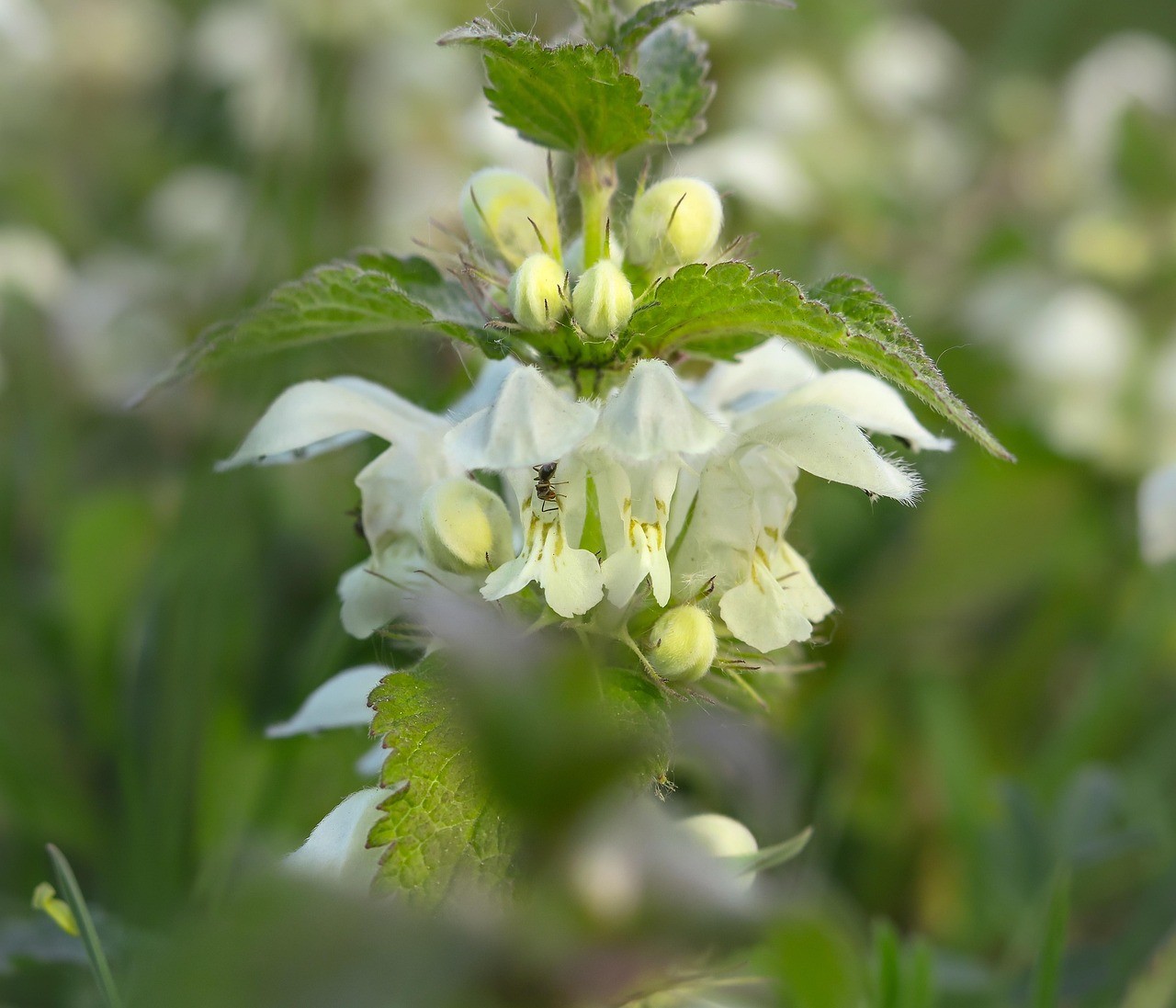
White deadnettle
Lamium album
A softly hairy perennial of the mint family, spreading by rhizomes into loose patches around 30–60cm tall, with square stems and coarsely toothed, nettle-shaped leaves that carry no sting. Hooded white flowers sit in whorls at the leaf joints from early spring onwards. Young leaves and shoot tips are mild and faintly earthy, cooked like spinach or added to soups, and the flowers are picked for salads.
Hedge banks, roadside verges, waste ground, farmyard edges and woodland margins on nitrogen-rich, disturbed ground, very often threaded through patches of stinging nettle. Common through England and Wales, thinner northwards in Scotland and local in Ireland.
No eating toxicity is known, and leaves and flowers are taken raw or cooked. The plant grows tangled through nettle patches, so wear gloves and look over each stem before gathering by the handful. Verge and path-edge stands carry traffic residue and dog fouling; pick well back from the edge.
Always use more than one reference to confirm a plant. You are responsible for what you choose to forage.
Flowers
White, two-lipped and hooded, about 2cm long, set in whorls of six or so where the leaf pairs meet the stem rather than in a terminal spike. This ring-of-white pattern is visible from several metres and rules out red deadnettle and the mints, which are pink to purple.
Leaves
Triangular to heart-shaped, coarsely toothed, pointed, and carried on clear stalks in opposite pairs. They look like nettle leaves at a glance but are soft to the touch, which is the quickest field separation from stinging nettle.
Stem
Square in cross-section and softly hairy, with the leaf pairs set at right angles to the pair below. Run a thumb up it: no prickling means the plant is not a nettle.
Smell when crushed
Faintly musty and green, not aromatic. If crushed leaves smell distinctly of mint or of any culinary herb, you have a different member of the family.
Updated 2026-08-08T12:03:09.806Z · Part of the shared Foragers Log catalogue · Herb