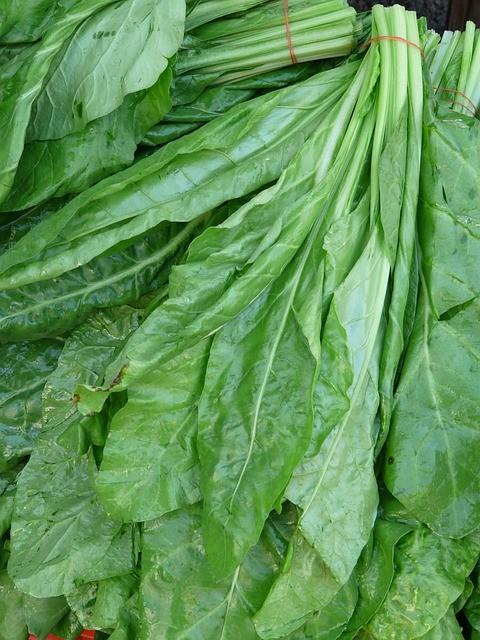
Spinach
Spinacia oleracea
A fast-growing annual grown for its soft, dark green leaves, which form a low rosette before the plant bolts. Blades are smooth or puckered, roughly spade- to arrowhead-shaped with two lobes at the base, and carried on long channelled stalks. Picked young for salads or cooked down for a fraction of its raw bulk; flavour turns bitter once flowering starts.
A cultivated crop rather than a wild plant in Britain and Ireland, grown in beds, allotments and polytunnels on moist, fertile, well-drained soil. It appears only as a short-lived casual outside cultivation, on tips, field margins and disturbed ground near where it was grown, and does not persist.
Generally safe eaten raw or cooked. The leaves are high in oxalates, so anyone prone to kidney stones or on a low-oxalate diet may want medical advice before eating large quantities regularly; cooking and discarding the water reduces the load. Leaves grown under heavy nitrogen fertiliser accumulate nitrate, so avoid picking from unknown, heavily fed ground.
Always use more than one reference to confirm a plant. You are responsible for what you choose to forage.
Leaf shape and stalk
Blade spade- to arrowhead-shaped with two backward-pointing lobes at the base, tapering into a long, channelled leaf stalk. The midrib stays thin and green rather than swelling into the broad white or coloured stem of chard and beet leaves.
Leaf surface
Hairless and slightly fleshy, either flat and smooth or heavily puckered depending on the type, with a matt bloom that beads water. No milky sap when a stalk is snapped.
Bolting
In long days the rosette lifts into an upright flowering stem and the new leaves become narrow and sharply arrow-shaped. This is the point at which the flavour turns bitter, so it is the most useful thing to check before picking.
Flowers and seed
Plants are usually either male or female. Flowers are tiny, green and petal-less, the males in a loose terminal spike and the females clustered in the leaf axils, the latter hardening into small burred fruits that are spined in prickly-seeded varieties.
Updated 2026-08-08T07:14:26.197Z · Part of the shared Foragers Log catalogue · Vegetable