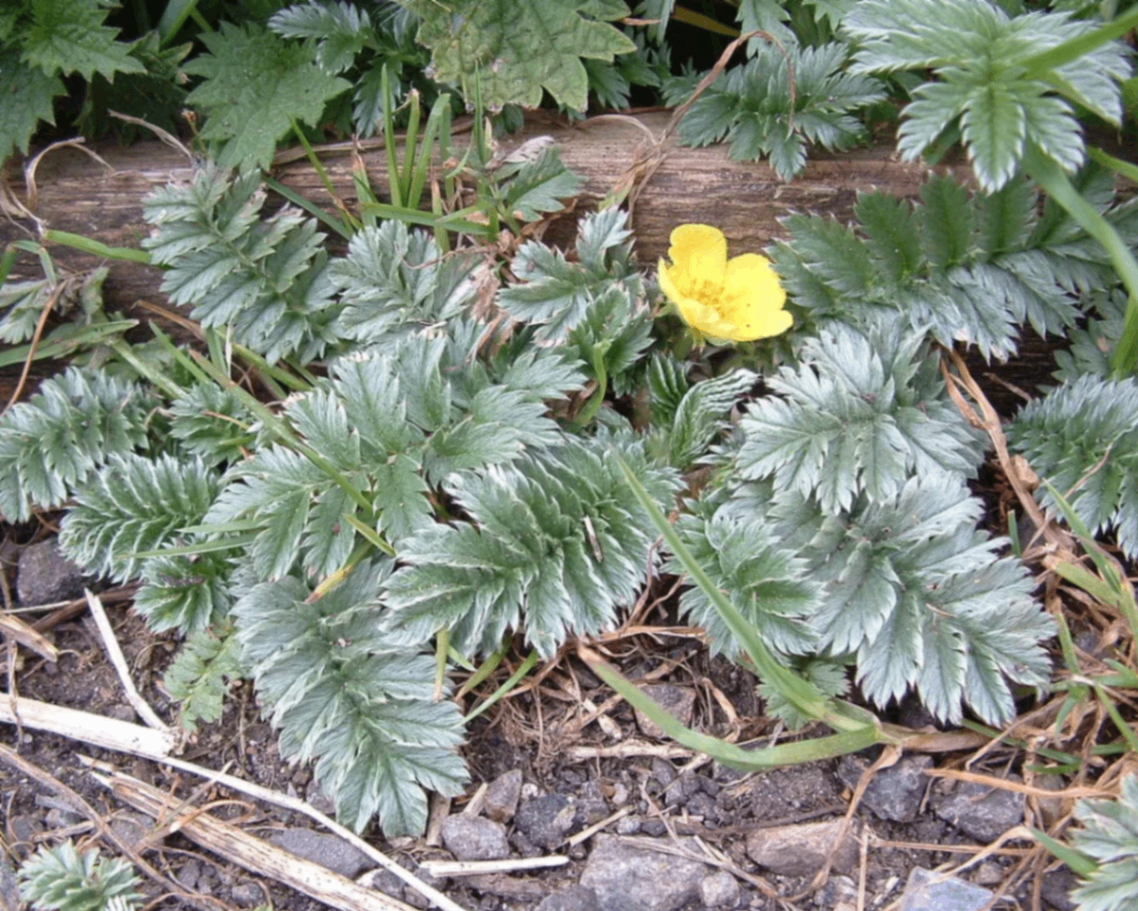
Silverweed
Potentilla anserina
A low, creeping perennial of the rose family, spreading by long red runners that root at the nodes. Its pinnate leaves carry many sharply toothed leaflets, alternating large and small along the stalk, and are clothed beneath in silky hairs that give the whole plant a silver cast. Solitary yellow five-petalled flowers rise on bare stalks through summer. The starchy roots were once a staple food in the Highlands and in Ireland, boiled or roasted.
Damp, open, disturbed ground: grazed grassland, track and path edges, roadside verges, dune slacks and the upper edges of saltmarsh. It tolerates trampling, compaction and brackish conditions, and is common throughout Britain and Ireland.
No known toxicity, and both leaves and roots have a long history of food use, though the roots are starchy and fibrous and are better cooked than eaten raw. It favours verges, tracks and grazed ground, so avoid sprayed, fouled or heavily trafficked sites. Digging up any wild plant requires the landowner's permission.
Always use more than one reference to confirm a plant. You are responsible for what you choose to forage.
Leaf shape
Pinnate, with 7–25 sharply toothed leaflets arranged in pairs along a central stalk, large leaflets alternating with much smaller ones. This rules out Creeping Cinquefoil and Tormentil, the other common yellow-flowered Potentillas, whose leaves are palmate — three to five fingers spreading from a single point.
Silver underside
The undersides are densely covered in flattened silky hairs and look almost white; the upper surface may be green or equally silvered. Turning a leaf over is the quickest confirmation from close range, and the silver shows from a distance when wind lifts a mat of foliage.
Growth habit
Forms flat rosettes linked by slender red-tinged runners that root where they touch, so plants spread in ribbons across bare or trampled ground rather than standing upright. There is no leafy erect stem.
Flowers
Single yellow flowers with five rounded petals, held on long leafless stalks arising directly from a rosette or runner node, one to a stalk. Agrimony, which has similar toothed pinnate leaves, carries its yellow flowers in a tall narrow spike instead.
Root
Slender, pale, tapering roots up to about pencil thickness, sweet and nutty when cooked. Size varies enormously with soil: worth digging on deep sand or river silt, barely worth the effort on hard clay.
Updated 2026-08-08T12:03:05.094Z · Added 2026-06-20T16:20:36.381Z
Part of the shared Foragers Log catalogue · Herb