Mizuna
Brassica rapa
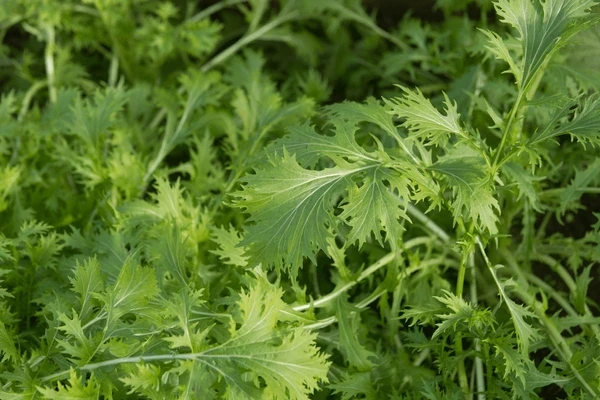
A fast-growing Japanese mustard green forming a dense rosette of glossy, deeply cut leaves carried on slender white stalks. It sits inside the sprawling Brassica rapa complex alongside turnip and pak choi, and the subspecies name is applied inconsistently across seed catalogues. What settles it in the kitchen is the feathery leaf and the mild peppery bite, gentler than rocket, eaten raw in salads or wilted at the end of cooking.
A garden and allotment crop rather than a wild plant, grown in beds, containers and polytunnels on moist, fertile soil. It stands cold and light frost well, and occasionally persists or self-seeds on disturbed ground close to cultivation.
No known eating toxicity; the leaves are taken raw and cooked. Like other brassicas they carry glucosinolates, so anyone managing a thyroid condition may prefer to keep large raw quantities moderate. Wash grit from the crowded leaf bases.
Always use more than one reference to confirm a plant. You are responsible for what you choose to forage.
Growth habit
A dense, upright rosette of many narrow leaves rising from a single central crown, often thirty or more on a mature plant. It does not form a heart or head, which rules out the pak choi and Chinese cabbage forms of the same species.
Leaf shape
Glossy dark green and pinnatifid, cut almost to the midrib into fine toothed segments so the whole leaf looks feathery. Rocket leaves, the nearest salad-bag equivalent, are lobed but far less finely divided and duller in surface.
Leaf stalk
Slim, white and juicy, no wider than a pencil and running the length of the leaf. The broad, flattened, spoon-like white stems of pak choi are a different plant despite the shared species.
Flowers when bolting
Four-petalled yellow flowers in loose branched spikes, the standard crucifer arrangement. Bolting is the signal that leaf quality has gone: the blades coarsen and the peppery note turns harsh.
Taste and smell of a crushed leaf
A light mustard smell and a mild peppery finish that fades quickly. A fierce, sinus-clearing heat suggests one of the true mustards rather than mizuna.
Updated 2026-08-07T20:52:29.102Z · Part of the shared Foragers Log catalogue · Herb