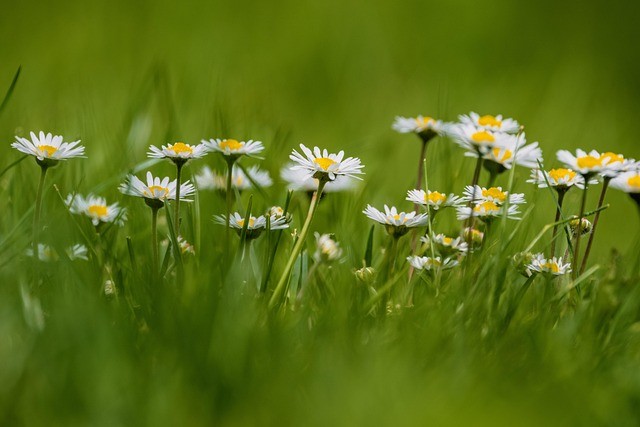
Daisy
Bellis perennis
A low, mat-forming perennial with a flat rosette of spoon-shaped, bluntly toothed leaves pressed against the turf, and single flower heads carried on leafless stalks only a few centimetres tall. The white ray florets, often flushed crimson beneath, surround a flat yellow disc, and the heads close at night and in dull weather. Young leaves and unopened buds are eaten raw in salads or pickled; older leaves turn bitter and tough.
Short, regularly cut or grazed grassland — lawns, playing fields, churchyards, verges and pasture — on most soils. Abundant throughout Britain and Ireland, from the coast to upland grassland, and tolerant of mowing and trampling.
No significant toxicity, though leaves become bitter with age and are best taken young and in modest quantity. People sensitive to other daisy-family plants may react to the flower heads. Most plants grow on mown lawns and verges, so avoid ground treated with selective weedkiller or fouled by dogs.
Always use more than one reference to confirm a plant. You are responsible for what you choose to forage.
Growth habit
A flat rosette hugging the ground, rarely more than 10cm tall in flower. It persists in closely mown turf, where taller white-flowered composites cannot survive.
Leaves
Spoon- to paddle-shaped with a blunt tip, shallowly toothed, softly hairy and narrowing into a broad stalk. They are undivided — nothing feathery or finely dissected as in the chamomiles.
Flower stalk
One head per stalk, the stalk leafless, unbranched and softly hairy, rising straight from the rosette. A branched, leafy stem carrying several heads is a different plant.
Flower head
Numerous narrow white ray florets, frequently crimson-tipped on the underside, around a solid yellow disc. Heads close in the evening and reopen in sun.
Taste test
Raw young leaves are mildly nutty at first with a bitter finish; buds are sharper. Strong bitterness on the first chew means the leaf is too old for salads.
Updated 2026-08-08T12:03:20.599Z · Part of the shared Foragers Log catalogue · Flower