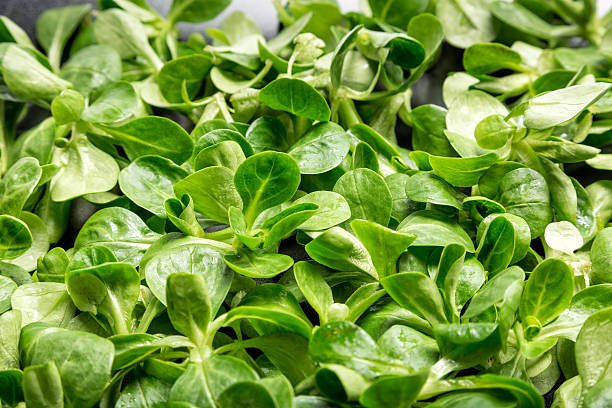
Corn salad
Valerianella locusta
A small winter annual forming a flat rosette of soft, blunt-tipped, spoon-shaped leaves, rarely more than 10cm across. In spring the rosette sends up repeatedly forked stems carrying dense heads of tiny pale lilac-white flowers. The young rosette is cut whole for salad — mild, faintly nutty and without bitterness, which is why it has long been grown in gardens as mâche or lamb's lettuce.
Open, dry, disturbed ground on light or lime-rich soils: sandy arable margins, coastal dunes and cliff tops, wall bases, quarry spoil and railway ballast. Widespread if patchy across lowland England, scarcer northwards and in Ireland, with frequent garden escapes.
No known toxicity, and the leaves are eaten raw with no preparation needed. Wild rosettes often sit on sprayed arable margins, path edges and wall bases, so wash them well and avoid dog-walked ground. Confirm the paired, untoothed, hairless leaves and the absence of milky sap before picking anything from a mixed patch of seedlings.
Always use more than one reference to confirm a plant. You are responsible for what you choose to forage.
Rosette form
A flat, ground-hugging rosette to about 10cm across, the leaves arranged in opposite pairs up a very short stem rather than spiralling outward. The paired arrangement is the first thing to check and rules out the alternate-leaved rosettes of dandelion-type plants.
Leaves
Spoon-shaped to oblong, blunt at the tip, untoothed or with one or two faint teeth near the base, smooth, slightly fleshy and hairless on both faces. Broken leaves and stalks give clear sap, not milk, which separates the rosette from young sow-thistles and dandelions growing in the same bare ground.
Flowering stems
Brittle, angular stems fork repeatedly and end in tight clusters of five-petalled flowers only 1–2mm across, pale lilac to nearly white. Once these appear the leaves are past their best, so the flowers are a season marker as much as an identification feature.
Fruit
The small dry fruit is rounded and corky with no crown of teeth at the top. Narrow-fruited cornsalad, Valerianella dentata, carries a distinct tooth or two on the fruit tip, and keeled-fruited cornsalad, V. carinata, has a deep groove down one face — all are edible, so this only matters for naming the plant.
Taste
Mild, slightly sweet and nutty, with no bitterness, pepperiness or aromatic smell. A rosette that tastes bitter or peppery is something else and should be put down.
Updated 2026-08-07T21:15:29.773Z · Part of the shared Foragers Log catalogue · Vegetable