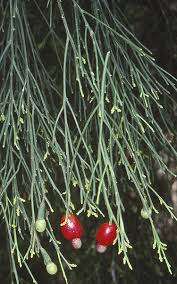
Native cherry
Exocarpos cupressiformis
A slender, weeping shrub or small tree whose fine drooping branchlets read as cypress rather than cherry, the true leaves reduced to minute scales so the green stems do the photosynthesising. The fruit is a small hard nut carried on a swollen stalk that ripens translucent red; the stalk is the part eaten, sweet and faintly resinous. An Australian species, not part of the British flora.
A root hemiparasite of dry sclerophyll forest and open woodland, tapping the roots of eucalypts and acacias through haustoria, and widespread in eastern and southern Australia including Tasmania. Absent from the wild in Britain and Ireland, where it occurs only in a handful of collections.
The edible part is the swollen fleshy stalk; the hard nut at its tip is astringent and normally spat out, as is any fruit picked before it turns translucent red. There is no British lookalike because the species does not grow wild here.
Always use more than one reference to confirm a plant. You are responsible for what you choose to forage.
Habit and foliage
Slender shrub or small tree to about 8 m, the crown made of fine, drooping, grooved green branchlets with leaves reduced to scales. The cypress-like outline is the first thing visible from a distance, and it rules out any true cherry, which carries broad toothed leaves on a stiffer crown.
Fruit structure
A green-brown nut roughly 4–5 mm across sits on top of a fleshy pedicel that swells and reddens as it ripens. The flesh is below the seed rather than around it — the reverse of a Prunus cherry, where the stone sits inside the flesh.
Flowers
Minute greenish-cream flowers without petals, packed into short spikes a few millimetres long along the branchlets. Nothing resembling the five-petalled blossom of a cherry or plum.
Root attachment
Hemiparasitic, forming haustoria on the roots of nearby eucalypts and other woody hosts. Plants are never found isolated from potential hosts, which is one reason the species is effectively absent from cultivation outside Australia.
Bark and trunk
Dark grey, fissured trunk bark contrasting with the smooth green of the current-season branchlets, so a mature tree looks conifer-crowned on a broadleaf-looking bole.
Updated 2026-08-07T20:41:53.654Z · Part of the shared Foragers Log catalogue · Fruit