Thyme
Thymus vulgaris
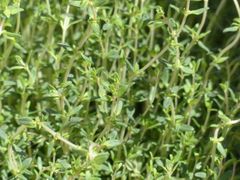
A low, densely branched woody subshrub reaching 15–30cm, with tiny grey-green leaves whose margins roll under and whose undersides are pale and downy. Crushed, they give the warm, resinous scent the plant is grown for. Small two-lipped flowers, pale pink to lilac, crowd the shoot tips through summer. This is the garden thyme of the kitchen rather than a British wild plant.
Native to the western Mediterranean and grown throughout the UK, where it wants thin, sharply drained alkaline soil and full sun. It persists on old walls, dry banks and rubble near habitation; thyme found on downland and dunes is usually wild thyme, Thymus drucei.
Safe in culinary amounts, fresh or dried. Concentrated thyme essential oil is a different matter, being irritant undiluted, and is not a kitchen ingredient. Strongly aromatic and hard to mistake, but pick away from roadsides and dog-walked verges.
Always use more than one reference to confirm a plant. You are responsible for what you choose to forage.
Habit
A stiff, woody-based subshrub that stands upright to about 30cm, woody at the base and only green at the shoot tips. Wild thyme (Thymus drucei) instead forms low creeping mats a few centimetres high, so height and woodiness separate them from two metres away.
Leaves
Very small, 4–8mm, narrow and untoothed, grey-green above with the margins rolled under and a pale downy underside. Marjoram and oregano, the other kitchen labiates it sits beside, have broader, flatter, clearly stalked leaves several times the size.
Stem
Square in cross-section on the young growth, as in all the mint family, becoming round and bark-covered lower down. Roll a shoot between finger and thumb to feel the four edges.
Smell
Crushed leaves release a warm, sharply resinous scent with a peppery edge. This is the decisive test: a small grey-green subshrub with no aromatic scent at all is not thyme, whatever the leaves look like.
Flowers
Two-lipped, 4–6mm, pale pink to pale lilac, packed into short rounded heads at the ends of the shoots from June. Whole flowering tips can be cut and dried with the leaves still attached.
Updated 2026-08-08T12:03:07.318Z · Part of the shared Foragers Log catalogue · Herb