Pak Choi
Brassica rapa
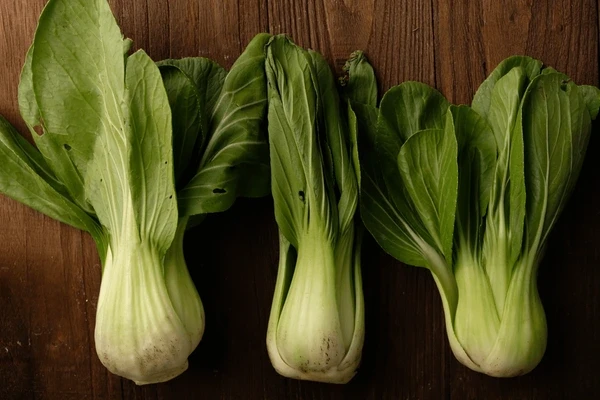
A compact non-heading Chinese cabbage forming a loose, vase-shaped rosette of smooth, glossy dark green blades on thick, fleshy white or pale green stalks. The whole plant is eaten, cut young as baby leaves or lifted as a full head, and the flavour is mild and faintly mustardy. Stalks stay crisp in stir-fries and soups while the leaves collapse in seconds.
A cultivated annual of fertile, moisture-retentive garden soil and raised beds, sown in cool conditions and often grown under cover or fleece in the UK to deter flea beetle. It bolts quickly in heat and long days, so is most reliable as a late-summer sowing. Not naturalised in Britain and Ireland, though it may self-seed briefly on disturbed ground where it has been grown.
No toxicity concerns; leaves and stalks are eaten raw or cooked. As with other brassicas it contains glucosinolates, which in very large sustained raw quantities have been linked to thyroid effects, so anyone with a thyroid condition may want to check further. Garden plants can carry slug pellet or spray residue, so wash well before use.
Always use more than one reference to confirm a plant. You are responsible for what you choose to forage.
Habit
An open, vase-shaped rosette with the outer stalks curving outward and the centre only loosely closed. It never forms the dense barrel-shaped head of Chinese cabbage (pe-tsai), and it stands upright rather than lying flat in a disc like tatsoi.
Leaf stalks
Broad, thick and fleshy, white to pale green, unmarked, and widening downwards where they overlap into a short base. The stalk makes up much of the plant's bulk and snaps cleanly rather than tearing.
Leaf blade
Smooth and glossy with an untoothed, slightly wavy margin and pale veins fanning out from the midrib. This separates it at a glance from crinkled kales and from the toothed or deeply lobed leaves of mustard greens and mizuna.
Bolting and flowers
In heat or long days the centre extends into a flowering spike carrying four-petalled pale yellow flowers, the standard cabbage-family arrangement. Once it bolts the leaves turn coarse and bitter, though the unopened flowering shoots are good eating.
Updated 2026-08-08T06:53:07.273Z · Part of the shared Foragers Log catalogue · Vegetable