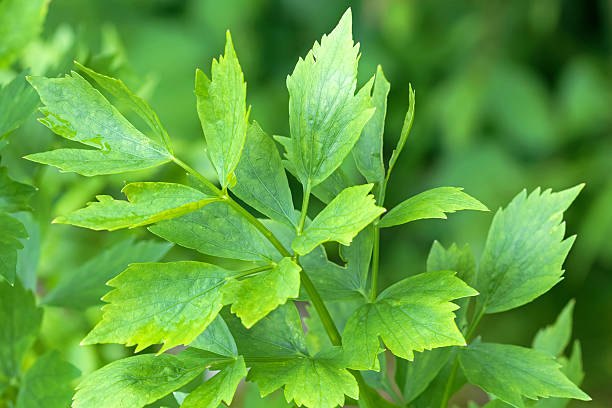
Lovage
Levisticum officinale
A big, upright umbellifer reaching two metres or more, with hollow ribbed stems and glossy dark green leaves divided into broad, wedge-shaped leaflets that are coarsely toothed towards the tip. Flat greenish-yellow umbels open in mid-summer. All parts smell intensely of celery and yeast, and leaves, stem and seed are used sparingly in stocks, soups and stews.
Not native to Britain. A long-established kitchen-garden herb of south-west Asian origin, persisting and occasionally naturalising near habitation on rough ground, old allotments, verges and walls. Prefers deep, moist, fertile soil in sun or light shade.
Edible in culinary quantities, and the flavour is strong enough that the quantity limits itself; the root is much more concentrated than the leaf. The sap carries furanocoumarins and can raise a burning rash on skin later exposed to sunlight, so cover arms when cutting in bulk. Anyone gathering an aromatic umbellifer should know hemlock water-dropwort (Oenanthe crocata), which is deadly: it grows in wet ditches and streamsides with finely divided, evenly toothed leaflets and a cluster of fleshy finger-like root tubers, where lovage has broad coarse-toothed leaflets and a single stout taproot on dry ground.
Always use more than one reference to confirm a plant. You are responsible for what you choose to forage.
Overall form
A single clump of stout, hollow, strongly ribbed stems, often 1.5–2.5 m tall by midsummer, standing well above most garden and verge herbs. Nothing else in a British kitchen garden combines that height with a celery smell.
Leaves
Glossy dark green, twice or three times divided, with broad wedge-shaped leaflets that are coarsely toothed and lobed only towards the tip and untoothed at the base. This coarse, angular cut is the quickest way to separate it from the fern-like, finely divided foliage of cow parsley and hemlock water-dropwort.
Flowers
Flat-topped umbels of small greenish-yellow flowers from June to August, with narrow bracts below. Most UK wild umbellifers of similar size carry white flowers, so the yellow-green cast is a useful check at a distance.
Smell when crushed
Crush a leaf between finger and thumb: the scent is a concentrated celery and yeast note, closer to stock powder than to a fresh celery stick. A faint, musty or carroty smell means you are not holding lovage, and the plant should be left alone.
Root
A single thick, fleshy, aromatic taproot with a pale yellowish cut surface, not a bundle of tubers. Worth checking on any plant being dug rather than picked.
Updated 2026-08-08T07:14:28.768Z · Part of the shared Foragers Log catalogue · Herb