Leek
Allium ampeloprasum
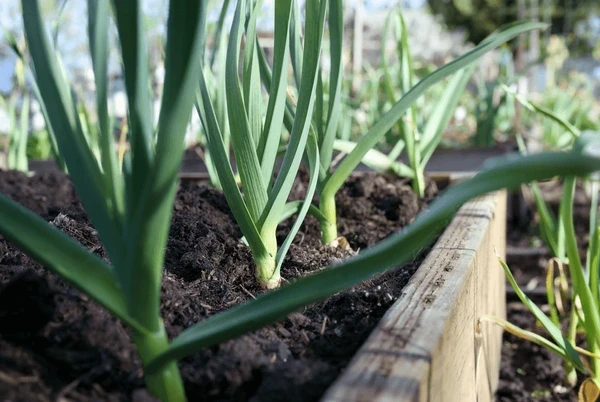
A stout biennial allium grown for its blanched pseudostem — a tight cylinder of rolled leaf bases rather than a true bulb. The flat, grey-green leaves fold along the midrib and rise in a flat fan from the stem. Sharply onion-scented when cut, mild and sweet once cooked, it is the standard overwintering allium of UK plots.
Cultivated in vegetable beds and allotments on deep, well-worked soil, needing a long season and standing hard frost. Its wild ancestor grows on coastal cliffs, dunes and rough ground in south-west England, Wales and Ireland, where it is local and scarce.
Safe cooked or raw for most people, though the outer leaves and the flower stalk of a bolted plant stay stringy however long they are cooked. Grit lodges between the leaf layers, so split the pseudostem lengthways and rinse. All alliums are toxic to dogs and cats.
Always use more than one reference to confirm a plant. You are responsible for what you choose to forage.
Leaves
Flat and strap-shaped, folded in a shallow V along the midrib, and set in one plane so the plant reads as a fan from two metres away. Onion and spring onion leaves are round and hollow in cross-section.
Pseudostem
A straight white to pale green cylinder of tightly rolled leaf bases, the same width from soil to leaf fan. There is no swollen bulb at the base, only a slight thickening and a mat of white roots.
Smell when cut
Cutting or crushing any part releases a clear onion scent. No allium smell at all means the plant is not a leek, and unrelated strap-leaved bulbs should be rejected on that test alone.
Second-year flowerhead
If left in the ground the plant throws a tall solid stem topped by a dense globe of pink to purple flowers in a papery sheath. Once this stem forms, the pseudostem is fibrous and no longer worth lifting.
Updated 2026-08-07T20:57:56.767Z · Part of the shared Foragers Log catalogue · Vegetable