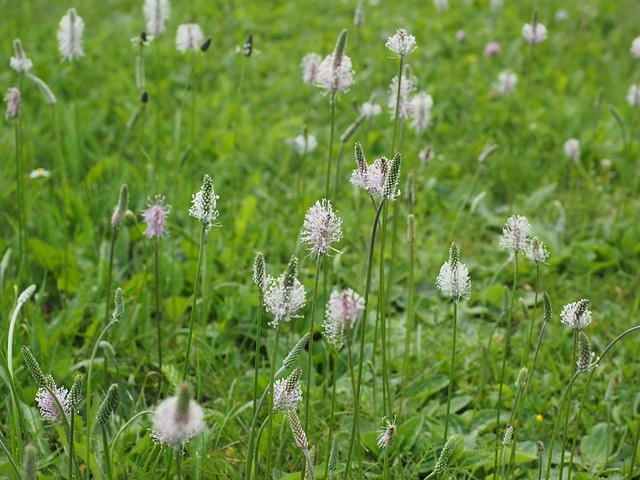
English plantain
Plantago lanceolata
A flat rosette of narrow, lance-shaped leaves, each with three to five strongly marked parallel ribs that pull out as tough elastic threads when the leaf is torn. Long leafless grooved stalks carry short, blunt brown-black flower heads ringed with cream stamens. Young leaves are mild and faintly mushroomy, eaten small in salads and cooked once they toughen.
Abundant throughout Britain and Ireland on grassland, lawns, verges, tracks, field margins and waste ground, tolerating heavy trampling and thin poor soils. Found from chalk downland to coastal turf, avoiding only deep shade and waterlogged ground.
No eating toxicity is recorded, though the tough lateral veins make older leaves stringy, so they are better cooked or strained than eaten raw. Plantain pollen is a recognised hay fever trigger. The plant favours verges, paths and playing fields, so pick well back from traffic, sprayed turf and dog fouling.
Always use more than one reference to confirm a plant. You are responsible for what you choose to forage.
Leaves
Narrow and lance-shaped, tapering at both ends and held in a low rosette, with three to five deep parallel ribs running the length of the blade. Greater plantain, by contrast, has broad oval blades on a distinct stalk.
Flower head
A short, blunt, brown-black ovoid head, rarely more than 2cm long, with a ring of cream stamens that rises up the spike as flowering progresses. Greater and hoary plantain both carry a long slender spike instead of this stubby head.
Flower stalk
Leafless, deeply furrowed with about five grooves, and much longer than the head it carries — often 20 to 40cm. The grooving is easy to feel between finger and thumb.
Torn leaf test
Tear a leaf across and the ribs separate as white elastic threads holding the halves together. There is no milky sap and no strong smell; a leaf that bleeds white latex or smells of onion is something else.
Updated 2026-08-07T20:52:28.091Z · Part of the shared Foragers Log catalogue · Fruit