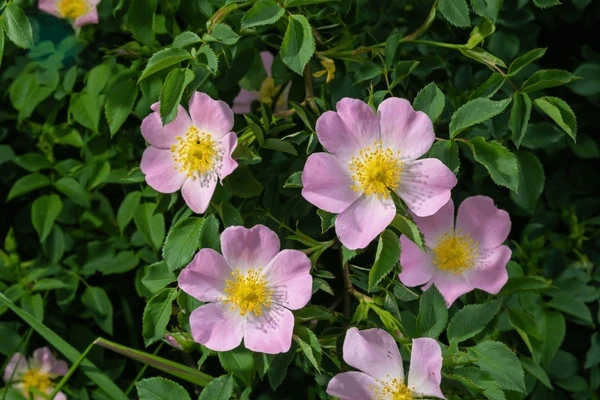
Dog rose
Rosa canina
A scrambling hedgerow rose whose arching stems climb through other shrubs to three metres or more, armed with stout hooked thorns. Five-petalled flowers, pale pink to white and lightly scented, open in early summer and are followed by smooth oval scarlet hips. Petals are used for cordials, syrups and vinegars; the hips, once the seeds and their hairs are removed, for syrup, jelly and tea. The species is split into many microspecies and hybridises freely with other wild roses, but the differences do not matter in the kitchen.
Hedgerows, scrub, wood edges, railway banks and rough ground on most soils, doing best on chalk and clay. Widespread and common across England, Wales and Ireland, thinning northwards through Scotland.
The hairs packed round the seeds inside a hip irritate the mouth and gut and must be removed; scrape the hips out or strain pulp and syrup through muslin. The hooked thorns tear skin and clothing readily. Avoid hedges alongside sprayed field margins and busy roads.
Always use more than one reference to confirm a plant. You are responsible for what you choose to forage.
Habit and thorns
Long arching stems scrambling up through hedges and scrub, often to three metres, rather than forming a dense freestanding bush. The thorns are stout, curved and broad-based, quite unlike the crowded straight bristles of Rugosa rose.
Flower
Five broad petals, notched at the tip, pale pink fading to near white, 4–5 cm across with a boss of yellow stamens. Borne singly or in small clusters through June and July, with only a faint scent.
Leaves
Pinnate, with five to seven toothed leaflets on a clear stalk, smooth and hairless above. Deeply corrugated, dull leaflets point instead to Rugosa rose; softly downy grey-green leaflets point to the downy roses.
Hips
Oval to egg-shaped, 1.5–2 cm, smooth-skinned and scarlet, hairless and without bristles. The sepals turn back and drop well before the hip ripens, leaving a clean scar; downy roses such as Rosa mollis keep their sepals erect on the ripe hip.
Inside a cut hip
Halve one before picking a bagful: the cavity is packed with pale seeds wrapped in dense, stiff hairs, with only a thin layer of orange flesh against the skin. That hair layer is the reason the hips need scraping or straining.
Updated 2026-08-08T06:52:52.646Z · Part of the shared Foragers Log catalogue · Flower