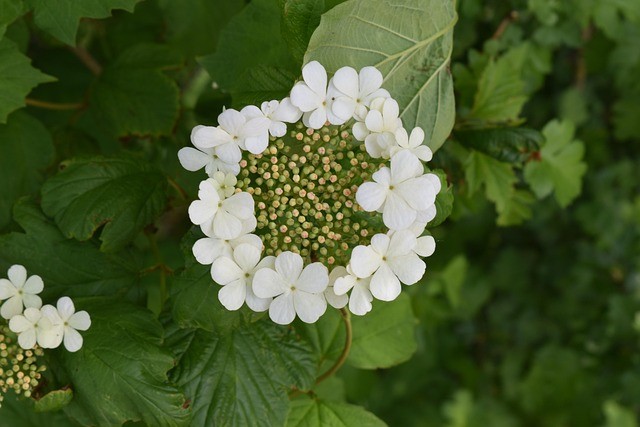
Guelder-rose
Viburnum opulus
Eating this will make you ill. Listed here so you can recognise and avoid it.
A spreading hedgerow shrub reaching about four metres, with opposite, three-lobed maple-like leaves that colour crimson in autumn. Flat lacecap flower heads open in early summer, a ring of large sterile white florets surrounding tiny fertile ones, and these give way to drooping bunches of translucent scarlet berries that hang on after the leaves fall. The fruit is bitter and needs cooking; it is traditionally made into a sharp jelly eaten with game.
Damp woodland edges, hedgerows, scrub, fen carr and streamsides, favouring moist, base-rich soils. Native and widespread across Britain and Ireland, thinning out in northern Scotland, and very widely planted in amenity hedging and roadside screening.
Raw berries are bitter and mildly toxic, and are known to cause nausea, vomiting and diarrhoea, especially when unripe or eaten in quantity; they should be cooked and the seeds strained out, and even cooked they are best eaten in small amounts. Wayfaring-tree (Viburnum lantana) grows in the same hedgerows and also passes through a red-fruited stage, but its leaves are oval, wrinkled and finely toothed rather than three-lobed, and its berries blacken as they ripen. Roadside and amenity plantings may be sprayed or salt-splashed.
Always use more than one reference to confirm a plant. You are responsible for what you choose to forage.
Leaves
In opposite pairs, three-lobed and coarsely toothed, shaped much like a small maple leaf and downy on the underside. This rules out Wayfaring-tree, whose leaves are oval and unlobed; field maple leaves are five-lobed and the tree carries paired winged keys rather than berries.
Flower heads
Flat-topped heads about 5-10cm across in June, with an outer ring of large, showy, sterile white florets surrounding a mass of tiny fertile ones. Elder heads, seen at the same season, are domed and made up of uniformly small flowers with a quite different, sweeter scent.
Berries
Rounded, glossy and translucent scarlet, hanging in loose drooping bunches from a single point, each containing one flattened stone. They stay red rather than darkening, and remain on bare stems into winter.
Leaf stalk
A close look at the top of the leaf stalk shows two to four small raised glands where it meets the blade, along with narrow leafy stipules at the base. A useful confirmation once the plant is out of flower and fruit.
Updated 2026-08-07T20:34:20.326Z · Part of the shared Foragers Log catalogue · Herb