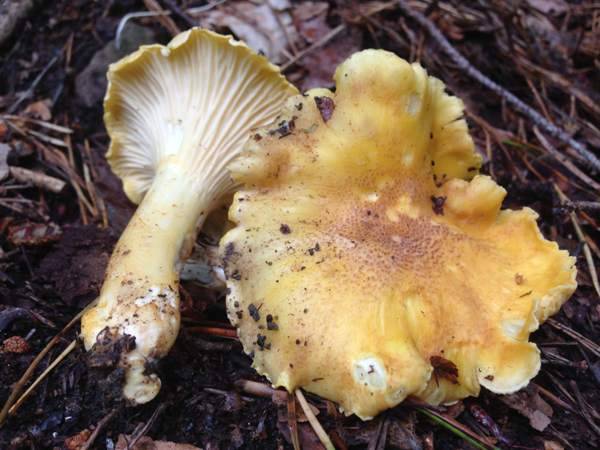
Amethyst Chanterelle
Cantharellus amethysteus
A funnel-shaped, egg-yellow fungus with blunt, forking ridges instead of true gills, set apart by a scattering of lilac to purple-grey scales across the cap surface. The flesh is white and fibrous, tearing in strands rather than snapping, with a faint apricot smell. Treated in the kitchen exactly as the common chanterelle, which some authorities still consider it a form of; the violet tones fade with age and heavy rain, so old specimens can look plain yellow.
Mycorrhizal with broadleaved trees, most often beech and oak and occasionally birch, fruiting in troops on mossy banks, acidic leaf litter and shaded path edges rather than on wood. Scattered through Britain and Ireland, commonest in long-established woodland in the south and west.
Cook it before eating; raw chanterelles are poorly digested and can cause mild stomach upset. Before any yellow, funnel-shaped fungus goes in the basket, turn it over and check for thick, blunt, forking ridges that run down the stem rather than thin, crowded, blade-like gills. Avoid roadside verges and recently sprayed plantation edges.
Always use more than one reference to confirm a plant. You are responsible for what you choose to forage.
Cap surface
Egg-yellow to pale apricot, overlaid with small lilac to purple-grey appressed scales or blotches, densest towards the centre. This is the one feature that separates it from the common chanterelle at arm's length, and it weakens in wet weather and with age.
Underside
Thick, blunt, irregularly forking ridges — not gills — running down onto the stem and continuous with the cap flesh, so they cannot be peeled off cleanly. Blade-like gills that separate from the flesh mean you have something else.
Flesh and smell
White throughout, fibrous, tearing into strands rather than breaking cleanly, and unchanging when cut. A faint smell of apricot or dried apricot when several are held together in a warm hand.
Growth habit
Solid-stemmed, never hollow, tapering towards the base, and growing scattered to gregarious in soil, moss and leaf litter. Anything fruiting in tight clusters directly on rotten wood is not this species.
Updated 2026-08-09T12:56:00.968Z · Added 2025-08-24T12:22:16.951Z
Part of the shared Foragers Log catalogue · Fungus