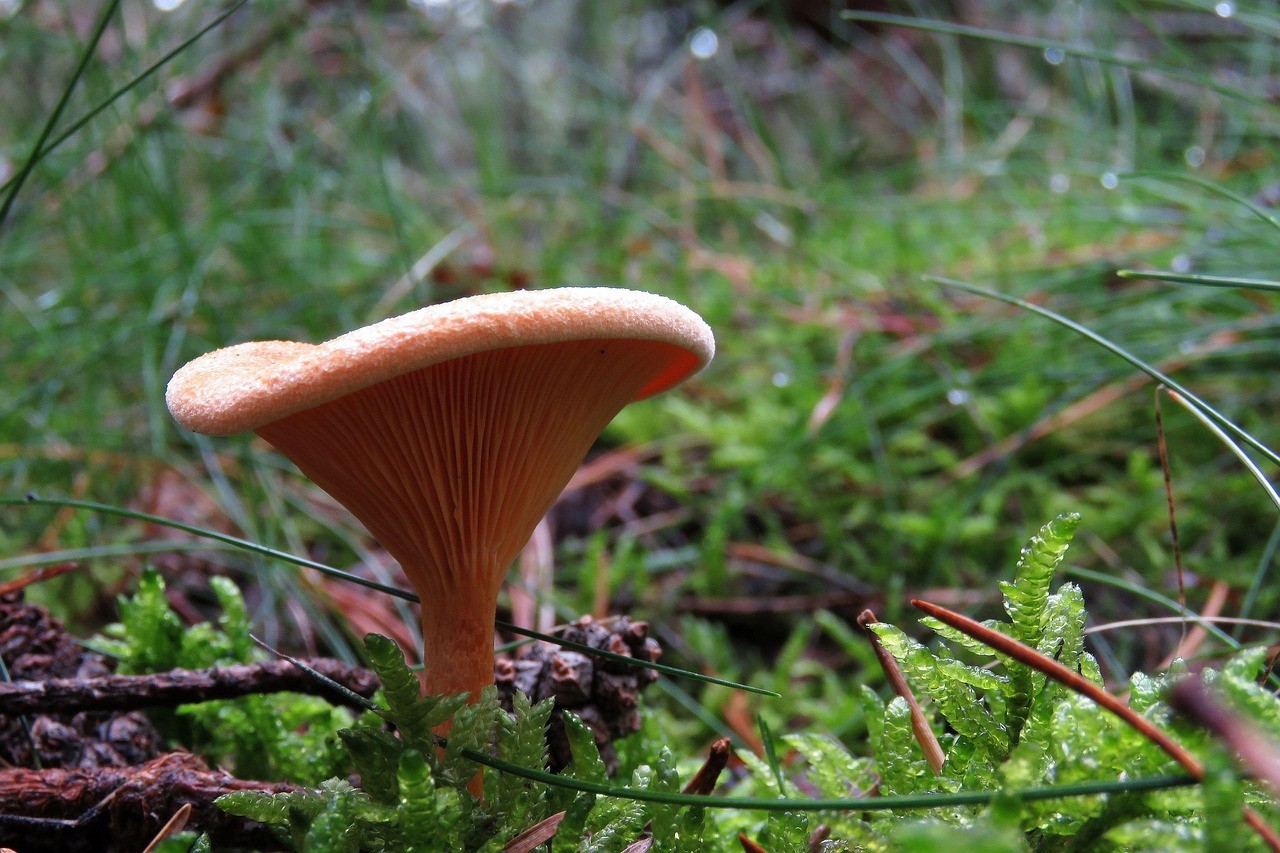
False Chanterelle
Hygrophoropsis aurantiaca
Eating this will make you ill. Listed here so you can recognise and avoid it.
A small, soft orange funnel of conifer woods that is taken at a glance for something better. The cap is finely velvety, deepest orange at the centre and paler towards an inrolled edge, and the underside carries thin, crowded, repeatedly forking true gills rather than the blunt shallow ridges of a true chanterelle. The flesh is thin, pliable and orange throughout, with little or no smell. Widely reported as edible but poor, and it disagrees with some people.
Saprotrophic on conifer litter, needle beds, wood chip and rotting stumps, especially pine and spruce; also on conifer-fringed heath and occasionally on burnt ground. Common and widespread throughout Britain and Ireland, fruiting from late summer into early winter.
Reported as edible but of poor quality, and there are repeated accounts of gastrointestinal upset, so it is better left alone than eaten. Jack O'Lantern (Omphalotus illudens), a toxic orange fungus found rarely in southern England, fruits in dense tufts from hardwood stumps and buried roots and has firm, thick flesh, not the thin pliable flesh and scattered conifer-litter habit seen here.
Always use more than one reference to confirm a plant. You are responsible for what you choose to forage.
True gills that fork repeatedly
Turn it over. The underside carries thin, crowded, blade-like gills that split into two again and again towards the cap edge, and they stand proud enough to catch a fingernail and tear. This is the decisive test on this species: shallow blunt ridges that look more like folds in the flesh than separate blades belong to something else.
Orange throughout, darker in the middle
Deep orange to orange-brown, usually browner at the centre of the cap and fading paler towards the rim, though colour varies a lot and old specimens bleach to buff. The gills are often a more vivid orange than the cap.
Funnel-shaped with a rolled-under edge
2–8cm across, convex at first then sinking into a shallow funnel, with the margin curled underneath and often wavy. The upper surface is finely felty or suede-like rather than smooth.
Thin soft flesh, orange rather than white
Tear the cap in half. The flesh is soft, spongy and no more than a few millimetres thick, coloured pale orange through to the stem, and it pulls apart cleanly. Thick white flesh that tears in fibrous strings is a different mushroom.
Little or no smell
Crushed flesh gives off nothing much — a faint mushroomy or slightly sour note at most. Any clear smell of apricots is worth stopping over, because it points elsewhere.
Growing on or near dead conifer wood
Often directly from a rotting stump, a buried root or a deep needle bed, singly or in loose troops. Fruiting on wood at all is significant, because the mushrooms it is mistaken for form partnerships with living trees and come up from soil.
Dry, finely velvety cap surface
The cap is matt and softly downy to the touch, not smooth and faintly waxy as in a true chanterelle. The texture shows best on a dry specimen in good light.
Slender stem, often curved or off-centre
The stem is thin, pliable and coloured like the cap, frequently bent or attached to one side. A true chanterelle has a stout stem tapering downwards with white flesh inside.
White spore print
Leave a cap gill-side down on dark paper for a few hours. A white print fits this species; a true chanterelle drops a pale cream to ochre-yellow print.
Updated 2026-08-08T12:03:16.316Z · Added 2026-07-18T11:22:53.793Z
Part of the shared Foragers Log catalogue · Fungus