Yarrow
Achillea millefolium
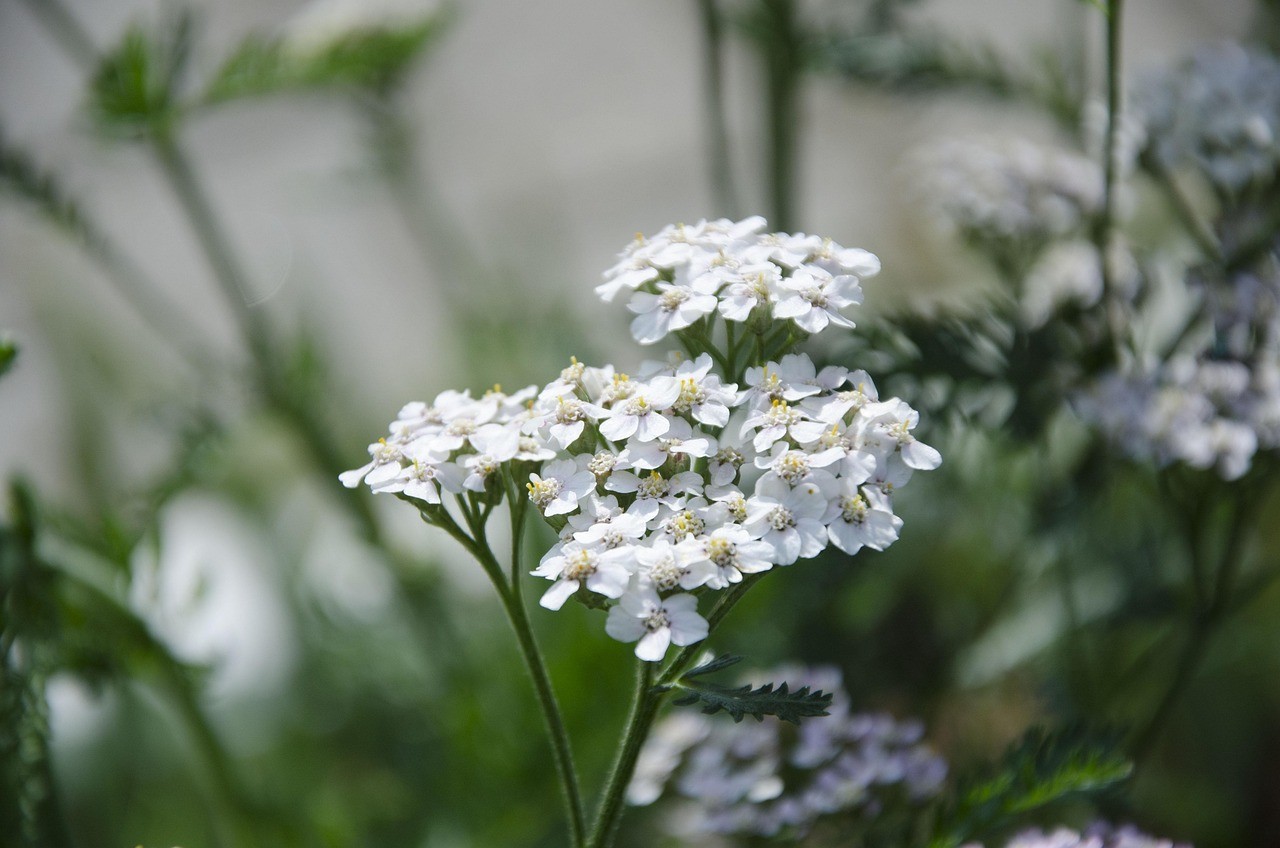
A tough, aromatic perennial of grassland, sending up ridged stems 20–60cm tall from spreading mats of finely divided, almost feathery leaves. The tiny flowerheads sit in a flat or slightly domed cluster, white to dusty pink, each one daisy-like with a few short broad rays around a cream centre. Young leaves are bitter and used sparingly in salads, soups and sauces, the flowering tops are dried for tea, and the plant was once a standard bittering herb in ale.
Meadows, pasture, road verges, lawns, churchyards and coastal dunes, on almost any dry or moderately drained soil. One of the commonest plants throughout Britain and Ireland, from sea level to hill grassland, and it persists in regularly mown turf as flat leaf rosettes.
Bitter enough that a little goes a long way; treat it as a seasoning rather than a salad base. Like other daisy-family plants it causes contact dermatitis in some people, and is reported to increase skin sensitivity to sunlight, so handle a first harvest cautiously. Traditionally avoided during pregnancy. Skip verges likely to have been sprayed.
Always use more than one reference to confirm a plant. You are responsible for what you choose to forage.
Flower cluster
Many small heads packed into a flat or slightly domed corymb, white or occasionally dusty pink. Close up each head is a miniature daisy with four to six short, broad rays around a cream disc, not the five separate petals of a carrot-family flower.
Leaves
Two to three times pinnate, cut into very narrow segments so the whole leaf looks feathery — the 'thousand leaf' of the species name. Soft-hairy and greyish-green, and much finer than the broader lobed foliage of any umbellifer.
Stem
Solid, tough and faintly ridged, downy, and usually unbranched until the flower cluster. It snaps rather than collapsing, and there is no hollow centre.
Smell when crushed
A sharp, sweetish, chrysanthemum-like scent with a bitter aftertaste on the tongue. A finely divided rosette leaf with no smell at all is not yarrow and should be left.
Habit
Spreads by rhizomes into loose patches, so leaf rosettes appear at ground level well away from any flowering stem — which is how it survives mowing and grazing.
Updated 2026-08-07T20:46:03.785Z · Part of the shared Foragers Log catalogue · Herb