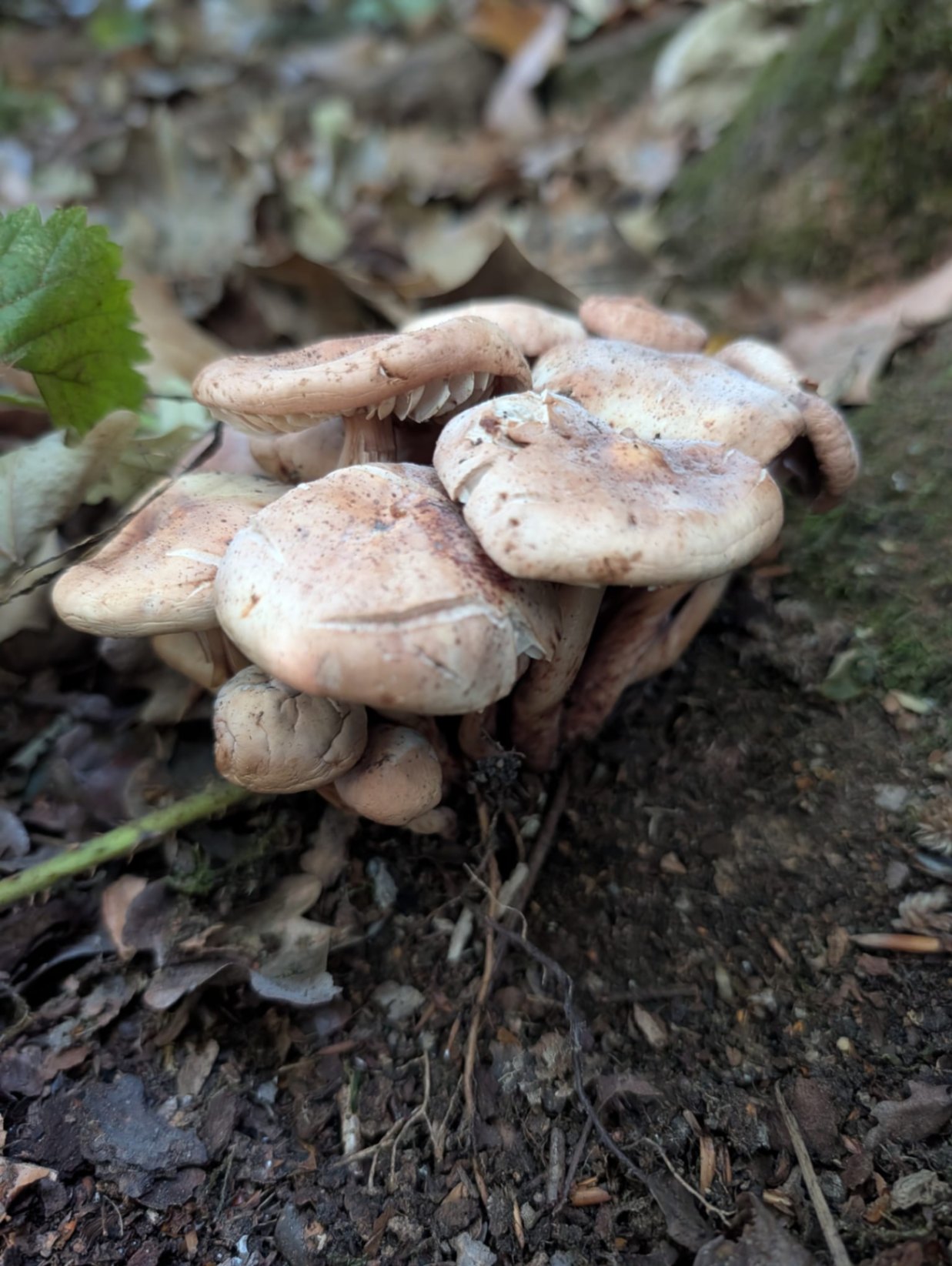
Spindle Toughshank
Gymnopus fusipes
Tough, chestnut to reddish-brown caps in dense tufts at the foot of an oak, on stems that swell in the middle and taper into a deep, twisting root. The widely spaced gills are whitish at first and freckle rust-brown with age. Young caps can be cooked, but the flesh stays leathery and older specimens are usually spoiled by larvae.
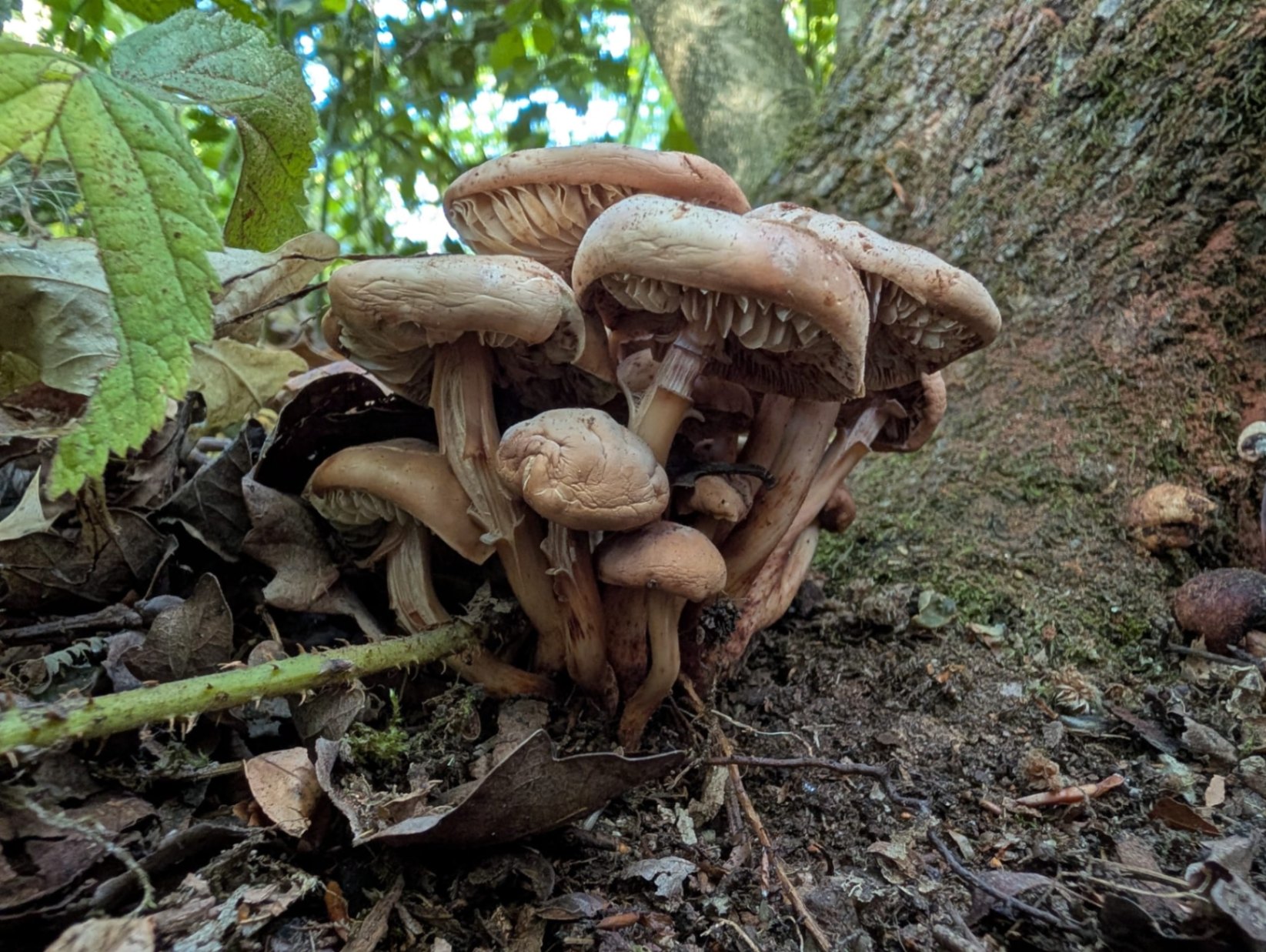
Parasitic on the roots of living broadleaves, above all oak, and less often beech and sweet chestnut. Fruits in clumps tight against the trunk base, or from buried roots a metre or two out, in woodland, parkland and hedgerows across much of Britain and Ireland.
Eat only the young caps, and only after thorough cooking; the stems are too tough and fibrous to be worth taking. Older fruit bodies are commonly riddled with larvae. Some foragers report stomach upset even from cooked material, so keep a first tasting small.
Always use more than one reference to confirm a plant. You are responsible for what you choose to forage.
Growth habit
Dense tufts of several to many caps fused at the base, pressed against the trunk foot of a living oak or arising from a buried root. Repeat fruitings occur on the same tree over many years.
Cap
3–8 cm, reddish-brown to chestnut, paler and often wavy at the margin, drying to tan. Older caps become blistered and irregularly lumpy rather than staying smoothly domed.
Stem
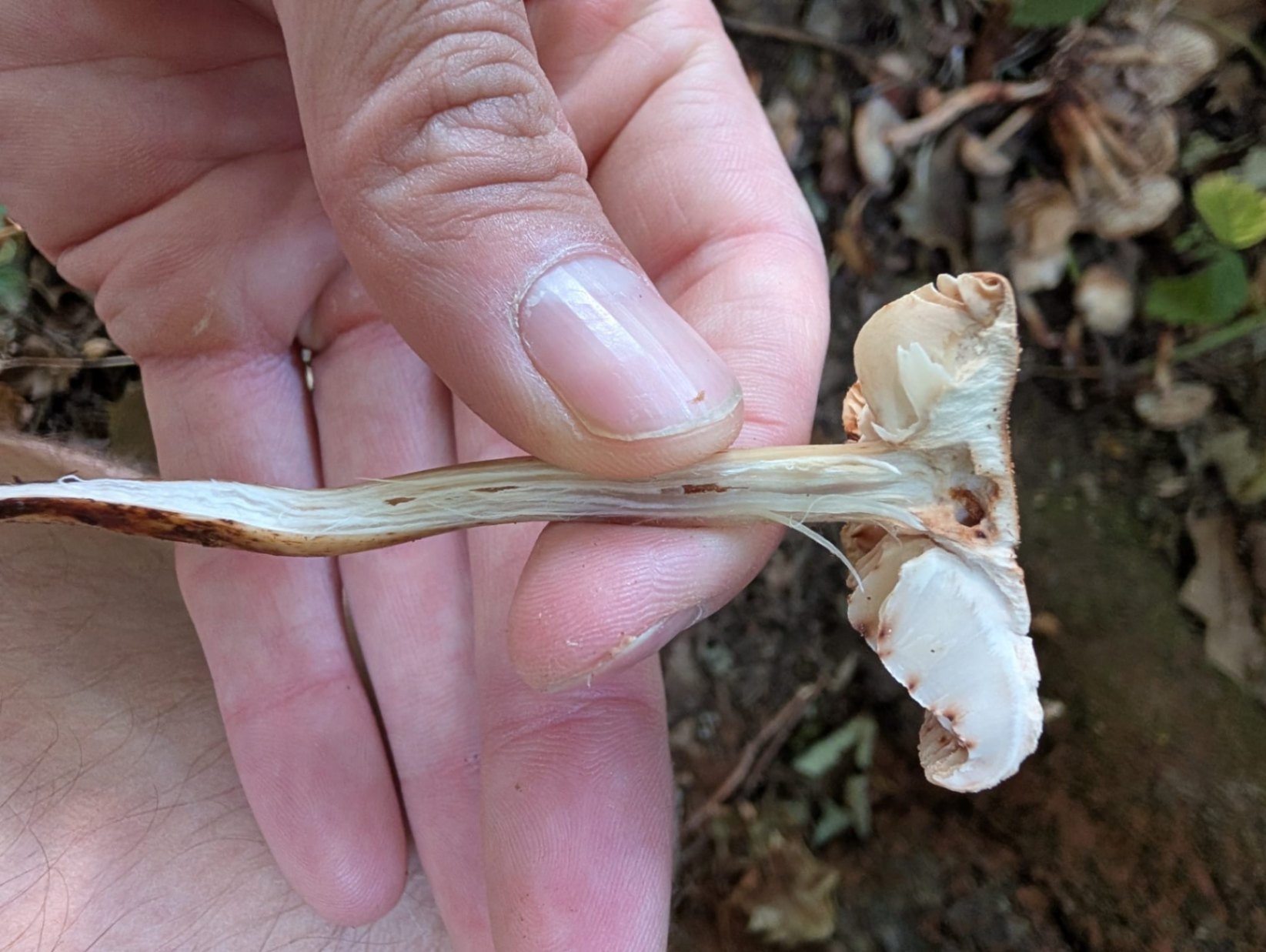
The decisive feature: swollen through the middle and tapering both upwards and down into a long, twisted, rooting base. Grooved lengthwise, tough and cartilaginous, reddish-brown darkening to almost black at the root, and it will not snap cleanly.
Gills
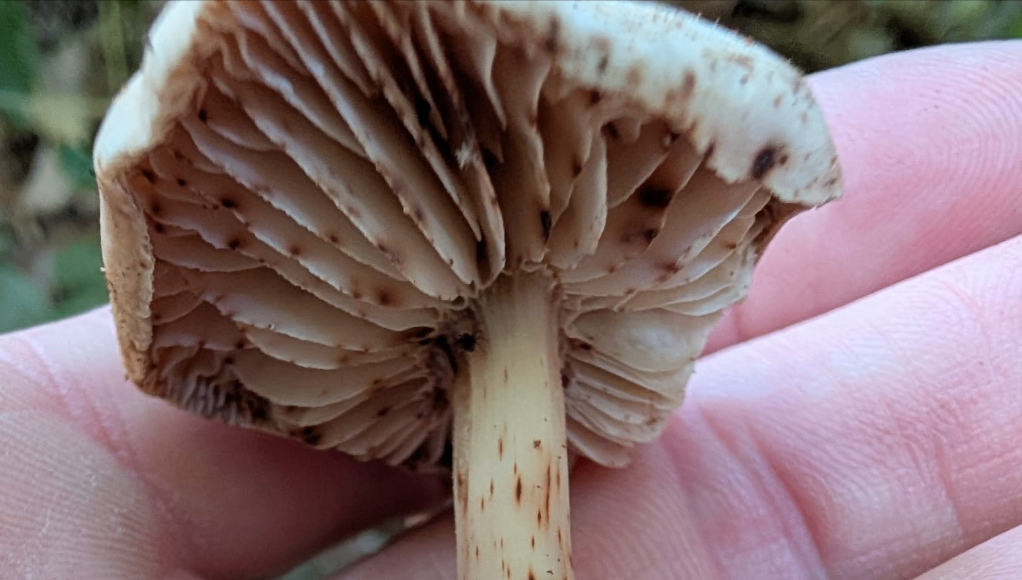
Widely spaced and rather thick, whitish to pale buff, freckling with rust-brown spots as they age. No ring is left on the stem, which rules out the ringed tuft-formers on stumps.
Spore print
White. Worth taking if the cap colour has led you towards a brown-spored species, since a rusty or purple-brown print points elsewhere entirely.
Updated 2026-08-08T09:25:19.726Z · Added 2026-08-08T09:05:18.767Z
Part of the shared Foragers Log catalogue · Fungus