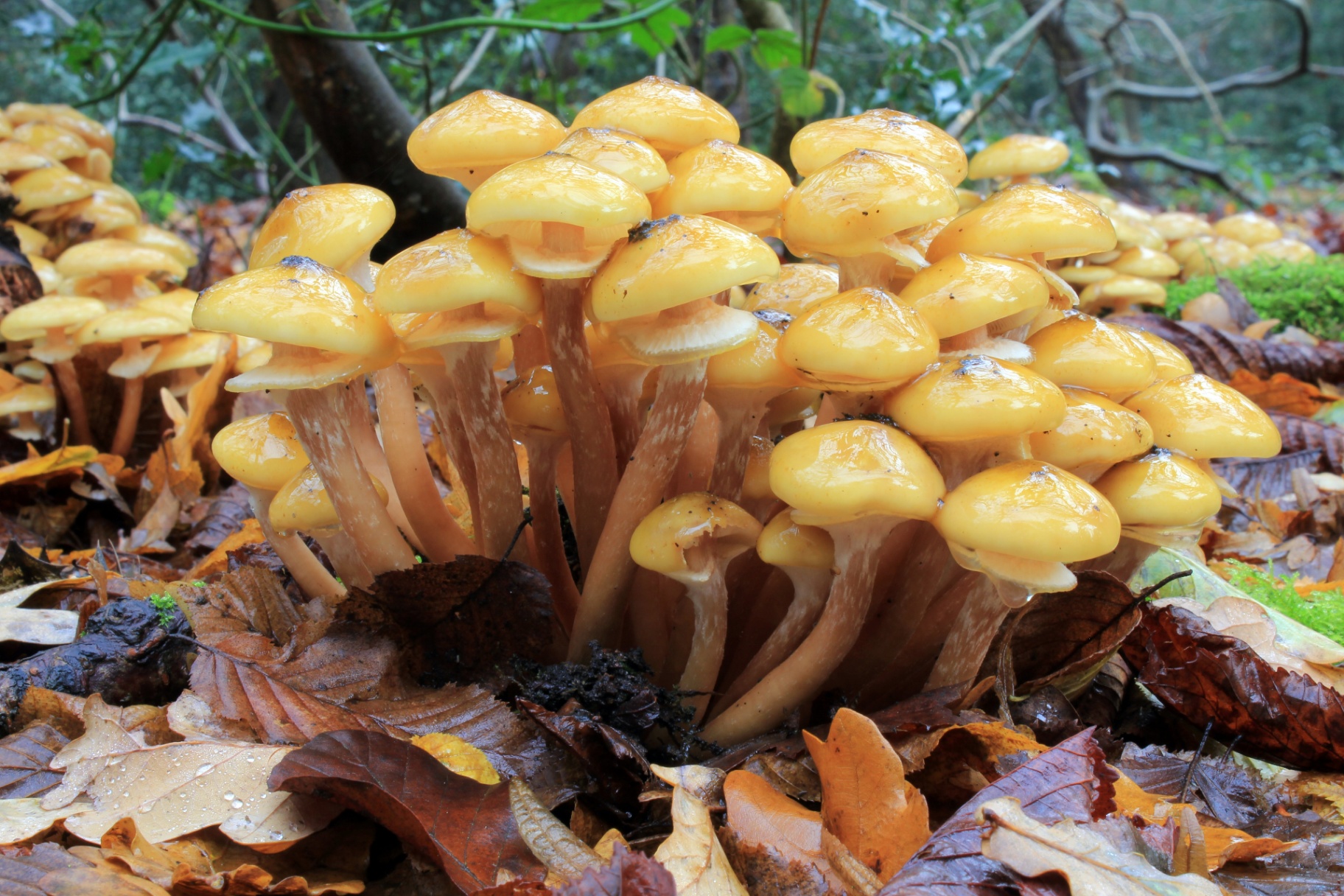
Honey Fungus
Armillaria mellea
Eating this will make you ill. Listed here so you can recognise and avoid it.
A tufted, honey-brown gill fungus that fruits in dense clumps at the base of living and dead broadleaf trees, on stumps and over buried roots. Caps are 4–12 cm, tawny to yellow-brown with fine darker scales towards the centre, over whitish gills that flush pinkish-brown with age, and a woolly ring sits high on a fibrous stem. A destructive parasite of trees in gardens and woodland, and edible only after thorough cooking.
Parasitic and then saprotrophic on broadleaves — oak, beech, birch, apple, willow and privet especially, occasionally conifers — spreading through soil and under bark by black, bootlace-like rhizomorphs. Common and widespread throughout Britain and Ireland in woodland, hedgerows, parks and gardens.
Never eaten raw or undercooked: it causes vomiting and cramps, and a minority of people react even to well-cooked, well-drained caps, so try a small portion first. Funeral Bell (Galerina marginata) fruits in similar tufts on dead wood but is smaller, with rusty-brown gills and a rust-brown spore print rather than the whitish-cream print seen here, and it is deadly. Sulphur Tuft (Hypholoma fasciculare) grows in comparable clumps on stumps but has a sulphur-yellow cap, greenish-grey gills, no ring, and an intensely bitter taste.
Always use more than one reference to confirm a plant. You are responsible for what you choose to forage.
Growth habit
Fruits in dense tufts of many caps sharing a common base, on stumps, trunk bases and over buried roots. Scattered single caps standing in soil away from wood are something else.
Cap surface
Honey to tawny brown, paler at the margin, with fine dark fibrillose scales concentrated towards the centre and slightly tacky in wet weather. The scales fade on older caps, so check several in a clump.
Ring on the stem
A persistent woolly whitish to yellow-tinged ring sits high on the stem. A clustered mushroom on wood with no ring at all is not this species — that points to Sulphur Tuft or Spindle Toughshank.
Gills and spore print
Gills start whitish and run a little way down the stem, later flushing pinkish to rust-spotted. The spore print is whitish-cream; a rusty-brown print rules the species out and raises the possibility of a Galerina.
Black rhizomorphs
Peel back loose bark or scrape the leaf litter around the tuft and look for flattened black cords like bootlaces running through wood and soil. These confirm the genus Armillaria rather than this species alone, but they rule out unrelated clustered woodland fungi.
Updated 2026-08-08T09:18:26.893Z · Added 2025-08-26T07:00:14.062Z
Part of the shared Foragers Log catalogue · Fungus