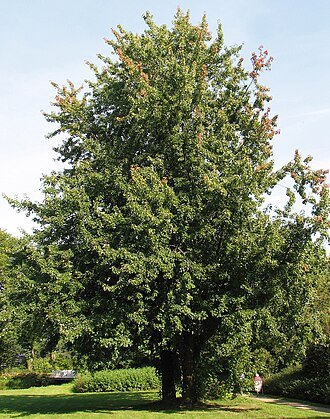
Silver maple
Acer saccharinum
A big, fast-growing maple with deeply cut five-lobed leaves that are pale silvery-white beneath, so the whole crown flickers in wind. Older trunks turn shaggy, flaking in long grey strips. It is tapped in late winter for a thin, watery sap that can be drunk fresh or boiled down to syrup, though it runs weaker than sugar maple's; the large paired seeds can also be boiled and eaten.
Not native here. A North American floodplain tree planted in UK and Irish parks, cemeteries, streets and riverside plantings, tolerating damp and heavy ground better than most maples. It seeds itself only occasionally, mainly in southern Britain.
No part is known to be poisonous to people, and the sap needs no preparation beyond straining before it is drunk or reduced. Tapping cuts into living wood, so it needs the landowner's permission — the usual latitude for picking fruit and foliage does not cover it, and repeated or oversized taps damage the tree. Street trees stand in road spray, so choose park or garden trees for sap. Wilted maple leaves are toxic to horses, so keep prunings out of grazing.
Always use more than one reference to confirm a plant. You are responsible for what you choose to forage.
Leaves
Five lobes cut more than halfway to the midrib, with narrow sinuses and sharply toothed margins, and a distinctly silvery-white underside. Sycamore leaves are shallowly lobed and dull green beneath, and Norway maple leaves are broader with fine bristle-tipped teeth.
Bark
Smooth grey on young trunks, becoming shaggy on older ones and flaking away in long vertical strips that curl at the edges. Sycamore sheds in irregular plates rather than strips, and Norway maple keeps a close network of shallow ridges.
Winged seeds
The largest samaras of any maple, each wing 3–6cm long, in widely divergent pairs that ripen and fall in late spring rather than autumn. Sycamore and Norway maple hold their keys until autumn.
Flowers
Dense clusters of small greenish to reddish flowers crowded on bare twigs in late winter, well before the leaves. This is one of the first maples in flower, and often the easiest way to pick the tree out in February.
Cut leaf stalk
Snap a leaf stalk and the sap runs clear and watery. A white, milky bead at the break means Norway maple, not this tree — the decisive check when the leaves are too high to see the undersides.
Updated 2026-08-07T20:46:16.294Z · Part of the shared Foragers Log catalogue · Other