Shaggy mane
Coprinus comatus
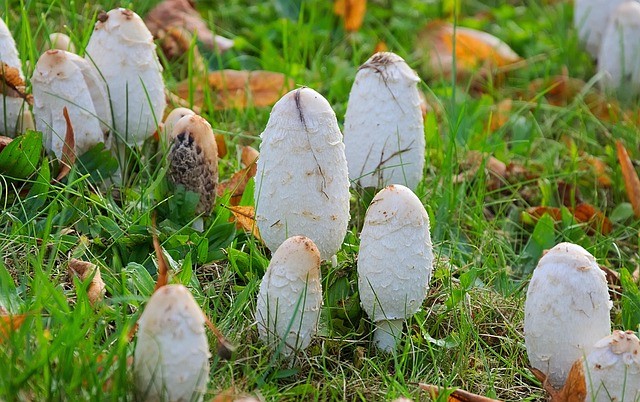
A tall white toadstool whose cylindrical, shaggily scaled cap stands closed like a rolled umbrella before dissolving from the rim upwards into black ink. The gills run from white through pink to inky black within a few hours, so the whole fruitbody is short-lived. Gathered young and firm, it has a mild flavour and a soft texture, and is best cooked the day it is picked.
Saprotrophic on disturbed, nutrient-rich ground rather than on wood: lawns, playing fields, roadside verges, path edges, car park margins and recently made or landscaped ground. Often in troops or lines. Widespread and common throughout Britain and Ireland.
Eat only caps that are still white and firm — the fruitbody digests itself within hours of picking, and any specimen blackening at the rim is past use. Unlike Common Inkcap it is not known to contain coprine, though a few people report stomach upset when it is eaten with alcohol. It fruits readily on verges and sprayed amenity grass, so weigh pollution and herbicide use before picking.
Always use more than one reference to confirm a plant. You are responsible for what you choose to forage.
Cap shape and scales
Tall and cylindrical to bullet-shaped, 5–15 cm high, white and broken into coarse shaggy scales with buff to brownish tips. The cap stays closed over most of the stem rather than expanding into a flat parasol, which is what separates it at a distance from the scaly Macrolepiota caps it can be mistaken for on lawns.
Gill colour sequence
Crowded, free gills that begin white, pass through pink, then blacken and liquefy from the cap rim upwards. Any pink or grey in the gills means the cap is already on its way out; solid white throughout is the only stage worth taking.
Stem and ring
A long, hollow, white stem with a thin, loose ring that often slips down towards the base. The base may be slightly swollen but never sits in a bag-like sac, so a fruitbody emerging from a membranous volva is not this species.
Cut test
Slice the cap lengthways before bagging. Firm white flesh throughout is good; grey, wet or already-inky flesh in the upper gills means it will be black liquid by the time you are home, whatever the outside looks like.
Growth pattern
Appears in troops, arcs or lines on soil and grass, often pushing up through compacted ground and gravel. It is not found growing on standing wood or stumps, which rules out the wood-rotting inkcaps and oyster-type fungi.
Updated 2026-08-08T11:13:29.317Z · Part of the shared Foragers Log catalogue · Fungus