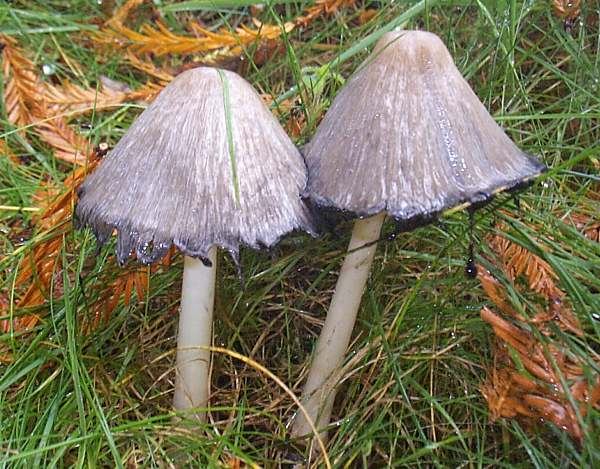
Common Inkcap
Coprinopsis atramentaria
Eating this will make you ill. Listed here so you can recognise and avoid it.
A tufted inkcap with a pale grey-brown, egg-shaped cap that opens into a ragged bell, finely scaly towards the centre and grooved at the margin. The white gills darken and dissolve into black liquid within a day of opening, so only firm, unopened caps are worth picking. It is eaten by some foragers when young, but it contains coprine and reacts badly with alcohol, which is why many leave it where it stands.
Saprotrophic on buried wood and rotting stumps, fruiting in dense tufts on lawns, verges, garden borders, path edges and disturbed ground rather than in closed woodland. Widespread and frequent throughout Britain and Ireland.
Contains coprine, which interferes with the breakdown of alcohol: drinking in the days either side of a meal can bring flushing, palpitations, nausea and headache. Caps deliquesce fast and should not be eaten once the gills have begun to blacken. It often fruits on verges and disturbed urban ground where soil contamination is a concern.
Always use more than one reference to confirm a plant. You are responsible for what you choose to forage.
Growth habit
Appears in dense tufts of many caps rising from a common base, on or over buried wood. Scattered solitary fruitbodies in open turf are more likely to be something else.
Cap
Grey to buff-brown, 3–7 cm, egg-shaped then opening to a ragged bell, with radial grooves running in from the margin and fine darker scales near the crown. It never carries the coarse shaggy scaling of Shaggy mane.
Gills and deliquescence
Crowded and very pale at first, turning grey then black from the edge inwards before dissolving into black ink. Any cap already inking should be left; the change can happen within hours of opening.
Stem
White, smooth, hollow and fibrous, with a low ridge or ring-like zone low down where the veil broke. There is no membranous ring on the upper stem and no sac at the base.
Updated 2026-08-08T12:29:21.130Z · Added 2025-08-25T05:15:42.020Z
Part of the shared Foragers Log catalogue · Fungus