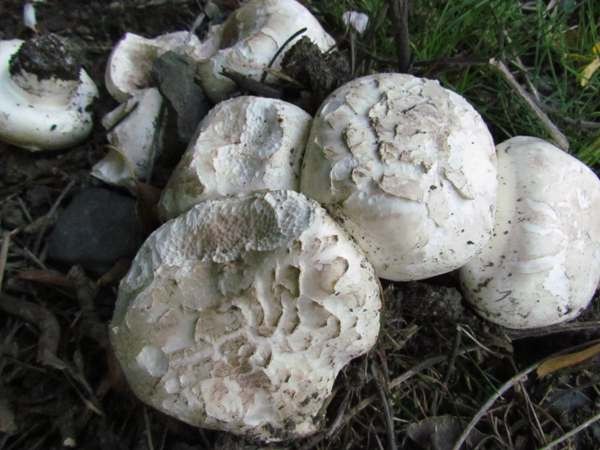
Pavement Mushroom
Agaricus bitorquis
A squat, thick-fleshed white to buff mushroom that shoulders its way up through compacted ground, sometimes lifting slabs and tarmac as it goes. The stem carries two rings — a narrow upper one and a sheath-like collar lower down — and the crowded gills darken from greyish pink to chocolate brown. Firm, slow to spoil, and used in the kitchen much as a shop mushroom, with a denser bite.
Saprotrophic on hard, disturbed, often nutrient-rich ground: path and kerb edges, car parks, gravel, building sites and cracks in pavement or tarmac. Widespread but patchy in lowland Britain and Ireland, and fruits through dry warm spells that stop other Agaricus.
No toxicity is recorded for this species; the growing site is the greater problem. Verges and pavements collect vehicle pollution, herbicide spraying and dog fouling, and Agaricus species take up heavy metals from contaminated soil, so pick well back from busy roads and cook thoroughly. Some people digest any quantity of Agaricus poorly.
Always use more than one reference to confirm a plant. You are responsible for what you choose to forage.
Stem rings
Two rings rather than one: a narrow upper ring and, lower down, a sheath-like collar with an upturned rim. This double banding is the feature the name refers to and separates it from the single-ringed field mushroom.
Cap and flesh
Low, flattened and very thick-fleshed, white to dingy buff, often cracked or scuffed and caked with soil from forcing through grit. The flesh is dense and firm rather than soft, and stays white or flushes only faintly pink when cut.
Gills
Free of the stem, crowded, pale greyish pink when young and darkening through purple-brown to chocolate. Gills that remain white at maturity mean the mushroom is not this species and should be left alone.
Smell
Pleasantly mushroomy both raw and in the pan. Any inky, phenolic or chemical note — sniff the crushed stem base — is a reason to discard the collection rather than cook it.
Growth habit
Singly or in small groups on compacted ground, often part-buried with only a dirty cap dome showing, and sometimes visibly buckling tarmac or paving. It is not found on wood or in leaf litter under trees.
Updated 2026-08-08T12:02:53.431Z · Added 2025-08-22T07:51:06.519Z
Part of the shared Foragers Log catalogue · Fungus