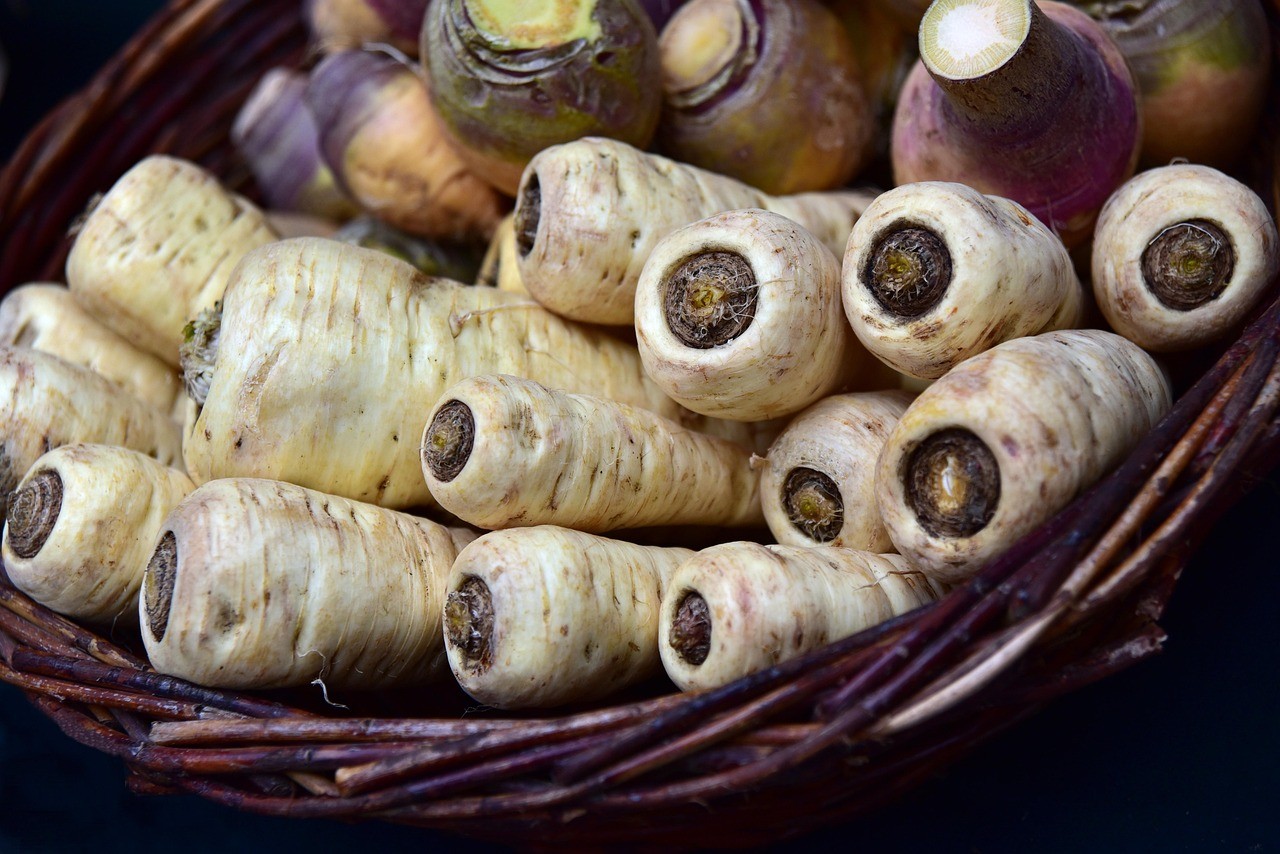
Parsnip
Pastinaca sativa
A stout biennial of the carrot family, grown for its sweet, cream-white taproot and also running wild on rough ground. First-year plants form a rosette of coarse, pinnate leaves with broad toothed leaflets; in the second year a ridged, hollow stem carries flat umbels of small yellow flowers. Roots are roasted, mashed or added to soups and stews, and taste sweeter after a frost.
Grown in gardens and allotments on deep, stone-free soil. Wild and naturalised plants favour chalk and limestone grassland, roadside verges, embankments and waste ground, commonest in central and southern England and scarce further north.
The root is safe to eat cooked or raw, but the sap of the leaves and stems contains furanocoumarins that cause blistering burns on skin exposed to sunlight, so wear gloves and long sleeves when handling plants in warm weather. Digging wild roots carries a far greater risk: hemlock water-dropwort (Oenanthe crocata) is deadly and its crown bears a cluster of finger-like tubers rather than the single tapering taproot of this plant. Leave verge-side plants where traffic pollution is likely.
Always use more than one reference to confirm a plant. You are responsible for what you choose to forage.
Flowering stem
Second-year plants send up a stout, deeply grooved, hollow stem to about 1.5m, topped with flat-topped umbels of small yellow flowers and no ring of bracts beneath. Yellow umbels are unusual among UK umbellifers; fennel also has them but its leaves are thread-like rather than broad and toothed.
Leaves
Pinnate, yellowish-green and slightly rough, with broad, coarsely toothed leaflets in opposite pairs along the stalk. This is a much coarser leaf than the finely divided, ferny foliage of carrot, hemlock or hemlock water-dropwort.
Root
A single, tapering cream-white taproot with a broad ridged shoulder and fine side rootlets. Any plant whose crown pulls up as a bundle of separate finger-like tubers is not this one and should be left alone.
Smell
Crushed foliage and cut root smell sweet and unmistakably of parsnip. A rank, mousy or musty smell instead points to hemlock and means the plant should be dropped and hands washed.
Updated 2026-08-07T21:15:20.973Z · Part of the shared Foragers Log catalogue · Vegetable