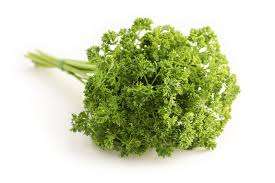
Parsley
Petroselinum crispum
A biennial umbellifer of the carrot family, usually grown as an annual, forming a low rosette of glossy bright green leaves that are divided three times and carried on long clear stalks — tightly curled in one form, flat and pointed in the other. Crushed foliage smells clean and sweetly green. In its second year it sends up a ribbed stem to around 75cm topped with flat umbels of small yellow-green flowers, after which the leaves coarsen. Picked fresh as a kitchen herb; the flavour fades with long cooking.
Not native to Britain and Ireland. A Mediterranean plant grown in gardens, allotments and pots on fertile, free-draining soil in sun or light shade. Where it is left to flower it self-seeds readily, and it turns up as a short-lived escape on walls, waste ground and old garden sites, rarely far from cultivation.
Safe as a culinary herb in normal kitchen quantities. The foliage contains furanocoumarins and handling large amounts can leave skin sensitised to sunlight, so a rash is possible after prolonged picking; the seed and seed oil are far richer in apiol than the leaf and concentrated preparations are traditionally avoided in pregnancy. Two umbellifers are mistaken for it when foliage is picked away from a garden bed. Fool's Parsley (Aethusa cynapium) hangs three long, narrow bracteoles below each partial umbel and smells rank when crushed, where parsley smells sweet. Hemlock (Conium maculatum) has hairless stems blotched and streaked purple and a stale, mousy smell, where parsley's stems are plain green and its scent clean.
Always use more than one reference to confirm a plant. You are responsible for what you choose to forage.
Growth form
A dense, low rosette of upright leaf stalks rising from a single crown, ankle-high in its first year. It does not spread by runners or form a sprawling mat, and it has no woody base.
Leaf
Triangular in outline and divided three times, the segments broad and bluntly toothed in the flat-leaved form, crimped and tightly curled in the curly form. Each leaf sits on a long, clear, hairless stalk, distinct from the soft, feathery, faintly downy foliage of wild hedgerow umbellifers.
Stem
Solid, finely ridged, hairless and an even green from base to top, with no purple blotching, streaking or bloom. Any purple mottling on the stem of a supposed parsley plant means stop and reidentify.
Flowers
Second year only: flat-topped umbels of tiny yellow-green flowers, with short, even bracteoles at the base of each partial umbel. Long, narrow bracteoles hanging down beneath the umbel like a beard belong to Fool's Parsley, not to this plant.
Smell when crushed
Crush a leaf between finger and thumb: the scent is clean, sweet and unmistakably of the kitchen. Anything rank, mousy, musty or of mice and stale sweat is a different umbellifer and should be left alone, whatever the leaf shape suggests.
Updated 2026-08-07T20:46:04.713Z · Part of the shared Foragers Log catalogue · Herb