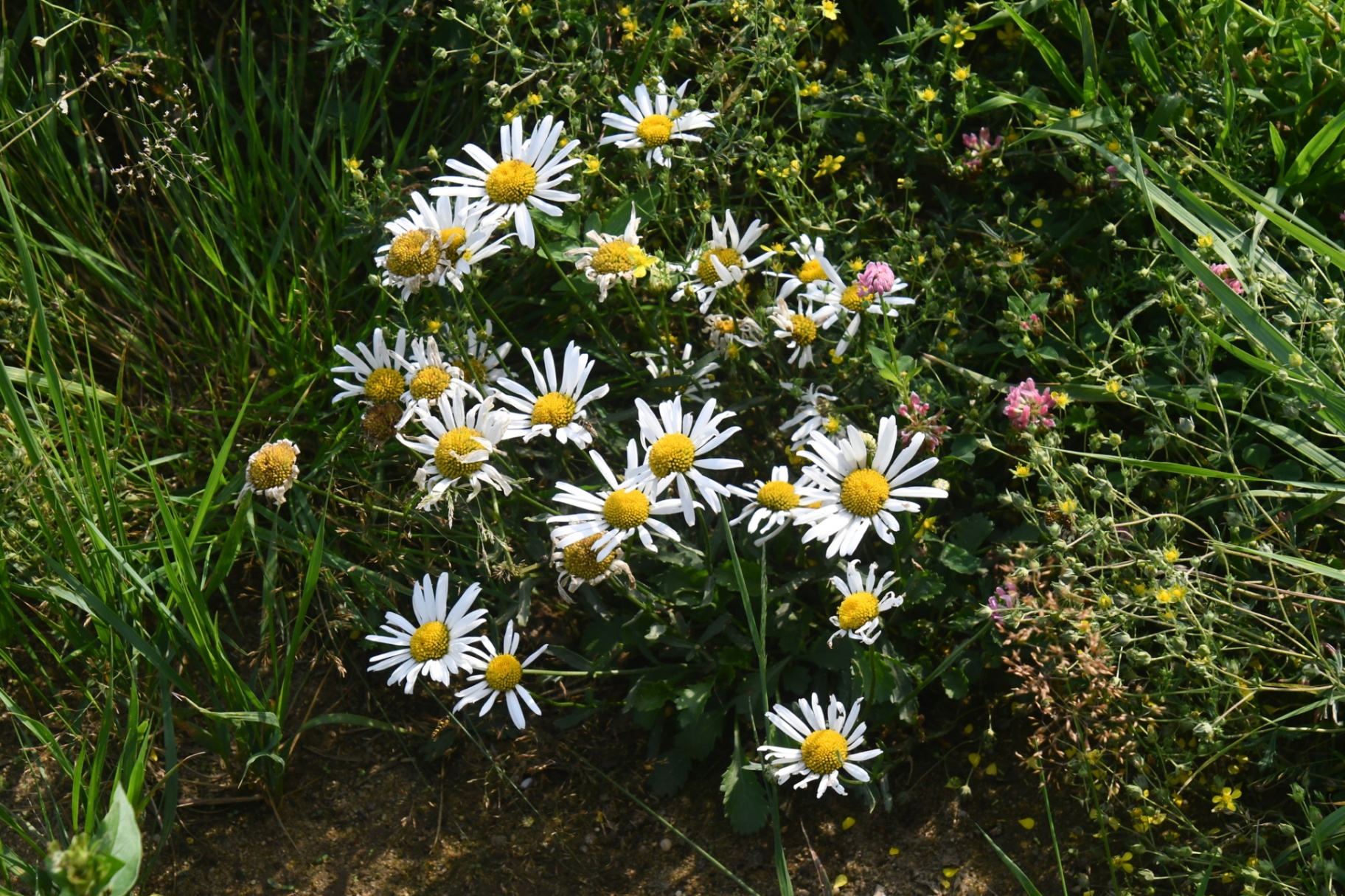
Oxeye Daisy
Leucanthemum vulgare
A grassland perennial of the daisy family carrying one flower head 3–5 cm across on each stem, with white ray florets ringing a flat yellow disc. The basal leaves are dark green, spoon-shaped and coarsely toothed, becoming narrow and stalkless higher up the stem. Petals are used raw in salads and the unopened buds are pickled; the leaves are strongly flavoured and bitter, so are used in small quantities.
A plant of unimproved meadows, road verges, railway banks, dunes and coastal cliffs, on well-drained neutral to calcareous soils. Common and widespread across Britain and Ireland, thinning in the far north-west.
No serious toxicity is recorded, but the foliage is bitter and strongly flavoured enough that most people use only small amounts. Handling the leaves can irritate the skin, and anyone who reacts to other daisy-family plants may want to be cautious. Verge and pasture plants may have been sprayed.
Always use more than one reference to confirm a plant. You are responsible for what you choose to forage.
One large white daisy per stem
Each stem carries a single flowerhead, 3–5cm across, with white ray petals around a flat yellow disc. Scentless Mayweed and Chamomile have several smaller heads on a branched, bushy plant, so the solitary head on a plain stem is the quick separator.
Flat, undivided leaves
The leaves are simple and toothed — spoon-shaped in the basal rosette, narrower and clasping up the stem — never feathery. This rules out the mayweeds and chamomiles, whose leaves are finely divided into thread-like segments.
Slender, mostly unbranched stem
The stem is thin, slightly ridged and usually rises undivided from a low rosette to bear its one flower, sometimes with a branch or two. It is a matter of a single stem and single bloom, not a leafy multi-flowered clump.
Head 3–5 cm across
A single large head on each stem, obvious from several metres away. This rules out the common daisy and the mayweeds, whose heads rarely exceed 2.5 cm.
Flat yellow disc
The central disc is flat to slightly domed and solid. Chamomile and pineappleweed have a distinctly conical receptacle that is hollow when cut lengthways.
Stem leaves clasp the stem
Basal leaves are spoon-shaped and on a clear stalk, while those up the stem are narrow, toothed and sit directly against it with no stalk.
Little scent when crushed
Crushed leaves and heads give only a faint sharp smell, not pleasant. A strong apple or pineapple scent means you have a chamomile or pineappleweed instead.
Updated 2026-08-08T12:03:20.989Z · Added 2026-07-22T19:25:06.216Z
Part of the shared Foragers Log catalogue · Flower