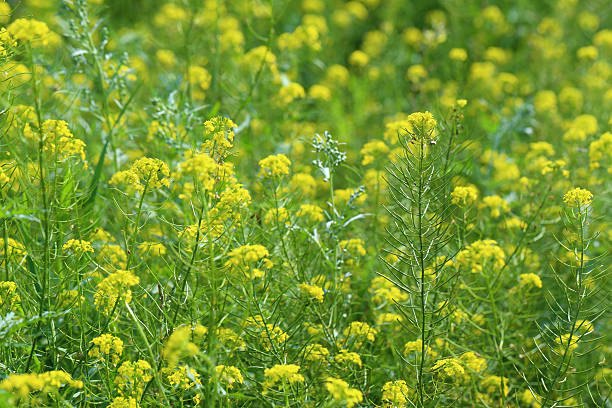
Mustard
Sinapis alba
A bristly annual of the cabbage family, usually 30–80 cm, with coarsely lobed lyrate leaves and loose spikes of four-petalled yellow flowers. The pods are the giveaway: a short bristly seed section topped by a long flattened beak. The pale straw-coloured seed is the base of English and American table mustard, the seedlings are the 'mustard' of mustard and cress, and young leaves are eaten raw or cooked.
Arable field margins, tracksides, tips and disturbed waste ground, favouring dry, light and calcareous soils. Widely sown in Britain and Ireland as green manure, fodder and game cover, so most stands are crop relics or escapes; commonest in lowland England.
No dangerously toxic lookalikes — the yellow-flowered crucifers it grows among are edible to varying degrees. The crushed seed is a strong irritant: mustard plasters can blister skin, and raw seed or coarse older leaves in quantity will burn the mouth and may upset the stomach. Plants on farmland are often sprayed or part of a sown crop, so seek permission before picking.
Always use more than one reference to confirm a plant. You are responsible for what you choose to forage.
Flowers
Bright yellow, four petals in a cross, about 1 cm across, carried in loose spikes at the tops of branched stems from June. Visible across a field margin but shared with most yellow crucifers, so it settles the family and nothing more.
Pods
Held out from the stem at a wide angle, bristly, with a lumpy seed-bearing section of 2–4 seeds topped by a flattened, sword-shaped beak as long as or longer than that section. This beak is the most reliable field feature and separates it at a glance from Black mustard and Charlock, whose pods have only a short point.
Leaves
Coarsely pinnately lobed with a large terminal lobe, roughly hairy and clearly stalked. The upper leaves are also lobed and stalked rather than clasping the stem, which rules out the turnip and rape relatives whose upper leaves wrap round it.
Stem
Branched, ridged and set with stiff downward-pointing bristles that are easily felt by running a finger up the stem. A smooth, hairless stem points to something else in the family.
Seed
Pale straw-yellow to sandy, roughly 2 mm and noticeably larger than the dark seed of brown or black mustard. Little heat when bitten dry; the pungency develops a minute or two after crushing and mixing with cold water, and is destroyed by hot water or vinegar added too early.
Updated 2026-08-07T20:52:33.929Z · Part of the shared Foragers Log catalogue · Herb