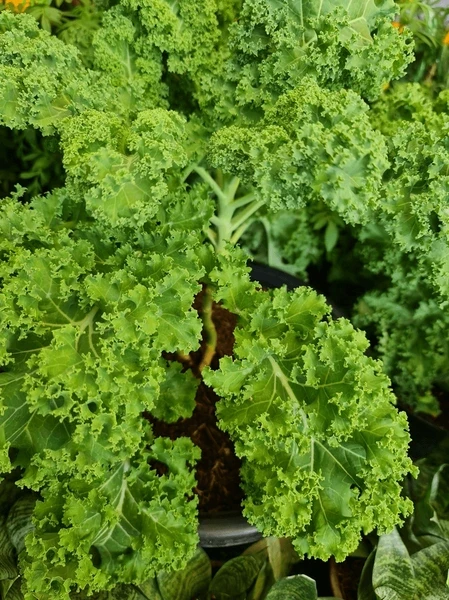
Kale
Brassica oleracea sabellica
A tall, non-hearting cabbage grown for its leaves rather than a head. Curled, blistered or flat blue-green leaves rise singly from a thickening upright stem, so the plant takes a palm-like shape as the lower leaves are picked off. It is hardy through hard frost, which converts starch to sugar and sweetens the leaf; the flavour is cabbage-like with a mustard edge.
A cultivated plant rather than a wild one in Britain and Ireland — grown in vegetable beds, allotments and containers on most soils, best in firm ground in full sun. Occasional self-sown plants appear on tips and waste ground but rarely persist.
No toxic wild lookalike in Britain. Raw leaves are tough and contain goitrogenic glucosinolates, so large raw quantities are worth avoiding by anyone managing a thyroid condition; cooking reduces them. Wash carefully, as soil and aphids sit in the crinkles.
Always use more than one reference to confirm a plant. You are responsible for what you choose to forage.
Growth habit
Leaves emerge one at a time from a single stout upright stem and never fold inwards. Nothing forms a heart or a curd — if the centre is tightening into a solid ball, the plant is a cabbage, not kale.
Leaf
Blue-green and waxy, with a pale thick midrib and a blade that is strongly crinkled and blistered in curly types or flat and strap-shaped in Cavolo Nero types. A finger drawn across the surface leaves a mark in the bloom.
Stem
Woody and increasingly bare towards the base, ringed with round leaf scars where lower leaves have been taken. Tall plants lean and need firming in or staking on exposed ground.
Flowering in the second year
From late winter the stem extends and produces spikes of four-petalled yellow flowers, the standard cabbage-family arrangement. Once the buds open the leaves turn bitter, so the shoots are best cut while still in tight bud.
Updated 2026-08-07T20:37:35.963Z · Part of the shared Foragers Log catalogue · Vegetable