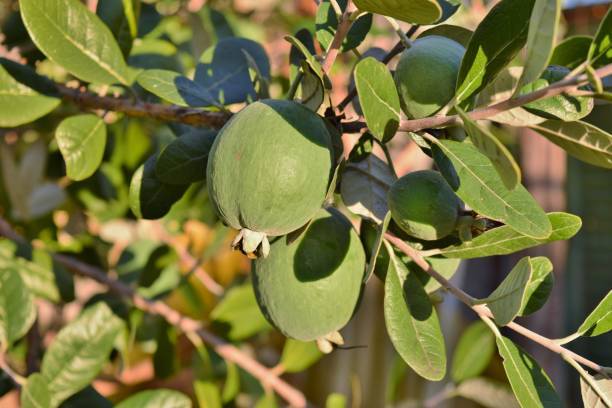
Feijoa
Feijoa sellowiana
A dense evergreen shrub or small tree with leathery leaves, glossy dark green above and white-felted beneath, grown in Britain chiefly as an ornamental and for its autumn fruit. The dull grey-green, egg-shaped fruit holds a granular, jelly-like pulp with a strong scent of pineapple and guava, usually halved and scooped with a spoon. The thick, sweet flower petals are also eaten.
Native to the highlands of southern Brazil, Uruguay and northern Argentina. In Britain and Ireland it occurs only as a planted shrub in gardens, parks and shelter plantings, and sets worthwhile fruit only in mild, sheltered sites such as coastal Cornwall, Devon and warm walled gardens.
No part of the fruit or flower is toxic and there is no realistic lookalike in Britain, as the plant is almost never found outside cultivation. Unripe fruit is hard, astringent and gritty; windfalls ferment quickly, so brown, collapsing flesh is spoiled rather than ripe. Fruit taken from ornamental or municipal plantings may have been sprayed, and picking from private gardens needs the owner's permission.
Always use more than one reference to confirm a plant. You are responsible for what you choose to forage.
Leaves
Opposite, oval, thick and leathery, dark glossy green above with a dense white or silvery felt beneath. The undersides flash pale as the wind turns them, which identifies the shrub from a distance in any season.
Flowers
Cupped flowers about 3-4 cm across with thick, fleshy petals, white outside and pink to purple within, surrounding a brush of long crimson stamens with yellow anthers. Borne singly in the leaf axils in early summer.
Fruit
Ellipsoid, roughly 4-7 cm long, dull grey-green with a faint waxy bloom, and tipped with the dried, persistent lobes of the calyx. Cut across, the flesh shows a firm gritty outer layer around a translucent, seedy jelly core.
Ripeness
Ripe fruit detaches itself and falls, so gather from beneath the shrub rather than picking. A fruit pulled from the branch is almost always underripe and astringent, and will only soften rather than sweeten indoors.
Scent
Cut or bruised ripe fruit gives a strong perfumed smell of pineapple and guava, noticeable at arm's length. A fruit with no scent is not ready; a sour or alcoholic smell means it has been on the ground too long.
Updated 2026-08-07T20:57:48.258Z · Part of the shared Foragers Log catalogue · Other