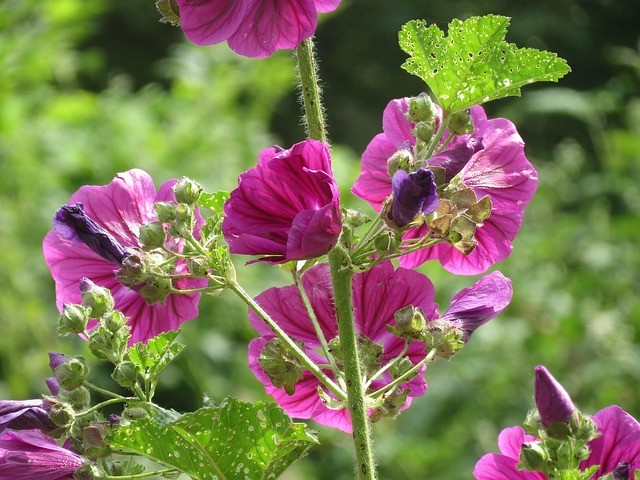
Common mallow
Malva sylvestris
A sprawling to loosely upright perennial with long-stalked, rounded leaves cut into five to seven shallow, crenate lobes, and pink-purple flowers of five notched petals lined with darker veins. The whole plant is markedly mucilaginous, and the leaves are used to thicken soups and stews; flowers and the flat green unripe fruits are eaten raw.
Dry disturbed ground — road verges, field edges, waste ground, sea walls and coastal banks — on sunny, well-drained soil. Common through lowland England and Wales, thinning northwards and largely coastal in Scotland and Ireland.
No toxic constituents are recorded, and leaves and flowers are eaten raw or cooked, but the mucilage is laxative in quantity, so keep a first helping small. Plants on manured or heavily fertilised ground can take up nitrates. Much of the population grows at dog height on verges and within spray of traffic; pick well back from the road.
Always use more than one reference to confirm a plant. You are responsible for what you choose to forage.
Flowers
25–40 mm across, with five bright pink-purple petals that are distinctly notched at the tip and marked with darker veins, the petals several times longer than the green calyx behind them. Smaller, paler, whitish-lilac flowers barely exceeding the calyx point instead to dwarf mallow.
Leaves
Rounded to kidney-shaped, 5–10 cm wide, with five to seven shallow blunt lobes and toothed edges, each held out on a long stalk. The lobes are shallow cuts into a disc, not separate leaflets.
Stems and habit
Coarsely hairy stems, tough and almost woody at the base, sprawling outwards then rising to around a metre. Plants often form a broad untidy clump rather than a single upright stem.
Fruit
A flat green disc about 6–7 mm across, made of roughly ten wedge-shaped nutlets packed in a ring; the segments become net-veined and wrinkled as they ripen and brown. This ring of nutlets is the readiest confirmation of the genus once flowering is over.
Crush test
A chewed or crushed leaf turns slimy rather than watery, and draws into threads. A leaf with no mucilage is not a mallow, whatever the leaf shape suggests.
Updated 2026-08-07T20:52:36.842Z · Part of the shared Foragers Log catalogue · Herb