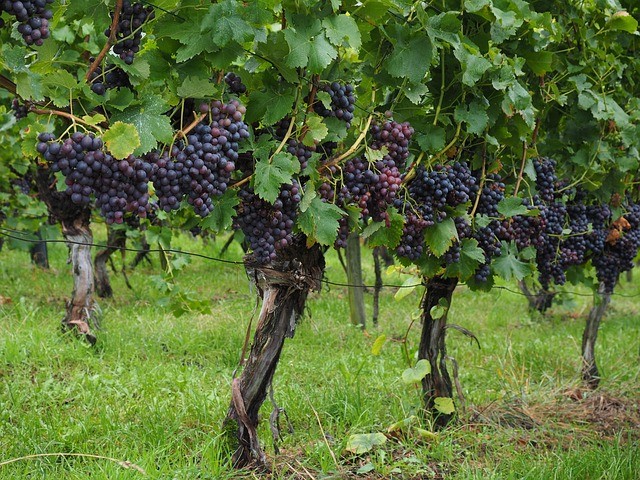
Common grape
Vitis vinifera
A vigorous woody climber that pulls itself up walls, trees and fences on forked tendrils, the older stems thickening and shedding bark in long strips. Leaves are broad and coarsely toothed with three to five lobes and a deep notch at the stalk. Dense sprays of tiny green flowers appear in early summer, followed by hanging bunches of round berries, green, amber or purple-black under a dusty bloom. This is the vine behind all wine and table grapes, and feral plants crop well in a warm year.
Not native to Britain and Ireland. Grown in vineyards and gardens and found as a garden relic or bird-sown escape on south-facing walls, railway embankments, waste ground and scrubby hedges, mainly in southern and central England where summers are warm enough to ripen fruit.
The ripe fruit is eaten raw or cooked and the young leaves are eaten cooked; underripe grapes are sharply acidic and can upset the stomach, and grapes are toxic to dogs. Two climbers carry grape-like bunches: Virginia creeper (Parthenocissus quinquefolia), whose leaf is divided into five separate leaflets rather than one lobed blade, and white bryony (Bryonia dioica), whose berries ripen red on a slender green stem that dies back each winter rather than a woody, flaking one. Vines on railway land and wall bases may have been sprayed.
Always use more than one reference to confirm a plant. You are responsible for what you choose to forage.
Leaf
A single broad blade up to about 15 cm across, palmately three- to five-lobed, coarsely toothed, with a deep notch where the stalk joins. It is one blade with lobes, not a leaf divided into separate stalked leaflets as in Virginia creeper.
Stem and tendrils
Older stems are woody, brown and shed bark in long strips; forked tendrils grip from points opposite the leaves. A green, bristly stem that dies back to the ground each winter is not a grape vine.
Fruit
Berries hang in a branched bunch, round to slightly oval, green, amber or purple-black with a dusty bloom, each holding one to four hard pips. Solitary berries or single-stalked clusters point to another climber.
Flowers
Small, green and petal-poor, packed into dense panicles in June with only a faint scent. Easy to miss, and worth noting as the position of the flower spray shows where bunches will hang.
Updated 2026-08-07T21:15:31.514Z · Part of the shared Foragers Log catalogue · Fruit