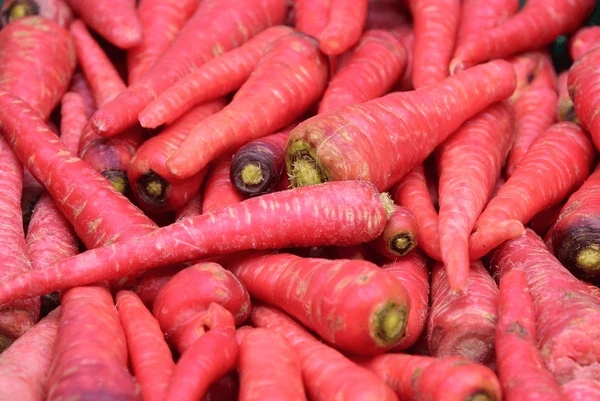
Carrot
Daucus carota
A biennial umbellifer grown for the swollen taproot it builds in its first year: smooth, tapering, usually orange, though purple, yellow and white forms are older and still sown. The finely divided leaves smell unmistakably of carrot when crushed. Left in the ground a second year it bolts to a flat white umbel and the root turns woody and bitter.
Grown in gardens and allotments on deep, light, stone-free sand or loam, where the root can run straight without forking. Self-sown plants persist on allotment margins and disturbed ground; the wild form is frequent on chalk grassland, dunes, sea cliffs and verges throughout Britain and Ireland.
The root is safe raw or cooked. Foliage and sap contain furanocoumarins that can blister skin exposed to strong sunlight, so cover arms when clearing a bed in hot weather. Anyone digging roots away from a cultivated bed needs certainty about the plant: hemlock water-dropwort (Oenanthe crocata) has a cluster of pale finger-like tubers rather than one tapering root and bleeds yellow juice when cut, and hemlock (Conium maculatum) has a smooth purple-blotched stem and a stale mousy smell instead of the carrot scent of crushed leaves.
Always use more than one reference to confirm a plant. You are responsible for what you choose to forage.
Root
A single tapering taproot with fine white lateral rootlets, orange in most modern cultivars but purple, yellow or near-white in older ones. One root, not a bunched cluster of tubers, and it is bitter and woody by the second summer.
Leaves
Triangular in outline and two or three times pinnately divided into narrow segments, on stalks with stiff bristly hairs. Crush a leaflet: a clear carrot smell is the quickest reassurance, and its absence should stop you.
Stem
Solid, ridged and roughly hairy on flowering plants. Smooth stems, hollow stems, or stems with purple blotches belong to something else in this family.
Flowers
A flat-topped compound umbel of small white flowers in the second year, often with one dark red-purple floret at the centre, above a ruff of finely divided, spreading bracts.
Seed head
As the bristly ridged fruits ripen the umbel contracts inwards into a concave cup, the "bird's nest" stage, which persists through winter on wild plants.
Updated 2026-08-08T12:02:57.573Z · Part of the shared Foragers Log catalogue · Vegetable