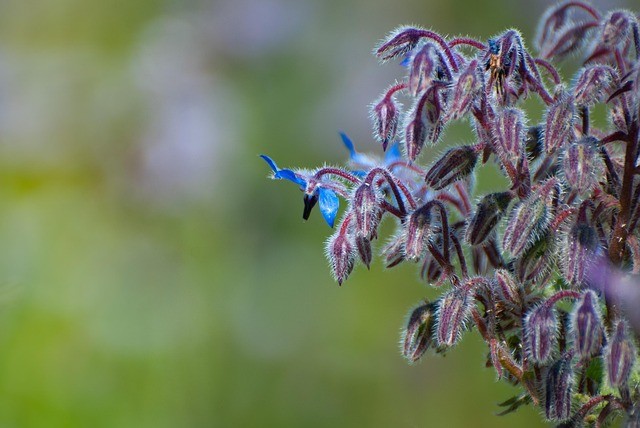
Borage
Borago officinalis
A bristly annual with hollow, brittle stems and nodding sprays of blue five-pointed flowers, the petals sweeping back from a black cone of anthers. Leaves and stems are covered in stiff white hairs, and crushed foliage smells clearly of cucumber. The flowers are used in drinks, salads and as a garnish; young leaves are chopped fine or cooked.
A Mediterranean plant long grown in gardens and widely naturalised in Britain and Ireland. Found on waste ground, allotment and field margins, roadsides and rubble on light, well-drained soil in full sun, usually close to current or former cultivation.
Borage contains low levels of pyrrolizidine alkaloids, so it is best treated as an occasional flavouring rather than a bulk green; anyone with a liver condition, and anyone pregnant, may prefer to avoid it. Comfrey (Symphytum officinale) shares the same rough ground and coarse bristles, but its leaf bases run down the stem as narrow wings and its flowers are drooping bells rather than flat blue stars. The stiff hairs can irritate skin and mouth, so pick young leaves and chop or cook them.
Always use more than one reference to confirm a plant. You are responsible for what you choose to forage.
Flowers
Five-pointed blue stars about 2 cm across, hanging on branched, curling stalks, the petals swept sharply back from a protruding black cone of anthers. White and pale pink forms occur. Other blue-flowered borages of rough ground, such as green alkanet, hold their flowers flat-faced with a small white eye and do not reflex the petals.
Stem and habit
An annual reaching 30–90 cm, with a hollow, brittle, branching stem that collapses readily when picked. It dies off completely after frost and returns from self-sown seed, rather than regrowing from a perennial rootstock.
Leaves and hairs
Oval to lance-shaped, wrinkled and alternate, the lower ones stalked and the upper ones clasping the stem but not running down it as wings. The whole plant is covered in stiff, whitish bristles that catch on the skin.
Crushed leaf smell
A crushed leaf or stem smells and tastes distinctly of cucumber. A hairy, blue-flowered plant of this shape with no cucumber scent is something else and should be left.
Updated 2026-08-07T21:05:50.369Z · Part of the shared Foragers Log catalogue · Herb