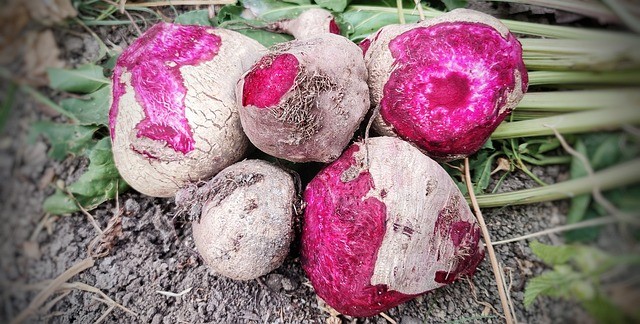
Beetroot
Beta vulgaris
A cultivated biennial grown for its swollen taproot: usually round to slightly flattened, deep purple-red, and marked with concentric paler rings when cut. The glossy oval leaves have crimson stalks and midribs and are eaten as a green in their own right. Roots are pulled small and sweet or left to bulk up for storing, and golden and white-fleshed cultivars come from the same species.
A garden and allotment crop rather than a wild plant, preferring deep, stone-free, well-drained soil in an open, sunny position. It sometimes persists on old vegetable plots and waste ground. Its wild ancestor, sea beet, grows on shingle and the upper edges of saltmarsh around the British and Irish coast.
No toxic parts, but the leaves carry oxalates and nitrate, so anyone prone to kidney stones may prefer modest, cooked portions. The pigment can colour urine and stools red for a day; this is harmless. Avoid self-sown plants on verges or contaminated ground.
Always use more than one reference to confirm a plant. You are responsible for what you choose to forage.
Leaves
Glossy, oval to heart-shaped leaves with wavy edges, carried on crimson stalks with a matching midrib. Leaf-beet and chard forms of the same species look much the same above ground but sit on a thin, unswollen root.
Root
A swollen taproot, round to flattened, sitting with its shoulders often pushed clear of the soil and tapering to a thin tail. Turnip and swede roots of similar shape have white or yellow flesh rather than deep red.
Cut flesh
Cut across, the flesh shows concentric rings of darker and lighter red and stains hands, boards and cloth immediately. Golden and white cultivars show the same ring pattern without the staining.
Bolting
In its second year, or after a cold check in its first, it throws up a tall ribbed flowering spike with tiny green flowers in clusters along the stem. The root goes woody at that point and is no longer worth lifting.
Seedlings
Each beet 'seed' is a corky cluster holding several seeds, so seedlings emerge in tight clumps and need thinning to one. A single, evenly spaced seedling usually means something else has germinated.
Updated 2026-08-07T20:37:42.993Z · Part of the shared Foragers Log catalogue · Vegetable