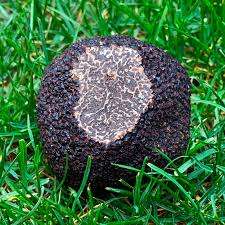
Winter Truffle
Tuber melanosporum
A hypogeous fungus, so the fruit body forms and ripens entirely below ground: a rounded to irregular tuber 2–7 cm across, covered in small black pyramidal warts. Cut open, ripe flesh is purple-black marbled with fine white veins, and the smell is deep and musky rather than mushroomy. The name "winter truffle" is also applied to Tuber brumale, a separate and much less valued species; the dense fine veining and sweeter, chocolate-like aroma settle it in the kitchen. Shaved raw over warm food rather than cooked.
Mycorrhizal, forming a partnership with oak and hazel on free-draining calcareous soils of high pH. Native to southern France, Spain and Italy. In Britain it is essentially a plantation species, with fruitings reported from inoculated hazel and oak in south Wales and southern England; wild occurrence here is not established.
No known eating toxicity, and the flesh is traditionally shaved raw rather than cooked. The usual mistake when digging is an earthball, Scleroderma citrinum: its interior is uniformly hard and purple-black without any white marbling, and it sits on the soil surface rather than fully buried. Digging also disturbs roots and soil — the Theft Act picking exemption covers picking, not uprooting, so landowner permission is needed.
Always use more than one reference to confirm a plant. You are responsible for what you choose to forage.
Ground signs above the tuber
Productive host trees often stand in a brûlé — a bare patch where herbaceous growth is suppressed around the trunk. Nothing is visible of the fungus itself; tubers sit 5–30 cm down, so this and a trained dog are the only reliable field clues.
Outer skin
Black to rust-black, covered in small pyramidal warts a few millimetres wide, usually four- to six-sided and slightly depressed at the tip. The warts rub down rather than flaking off in plates.
Cut flesh
Purple-black when ripe, marbled with fine, closely spaced white veins that flush reddish-brown on exposure to air. Pale grey or brown flesh means an immature tuber, not a different species.
Smell
Deep and musky-sweet, with notes of damp earth and cocoa, carrying well from a freshly lifted tuber. A sharp, peppery or turnip-like smell points to Tuber brumale instead, which also has sparser, coarser veining.
Updated 2026-08-08T12:03:25.019Z · Added 2025-08-25T21:16:39.318Z
Part of the shared Foragers Log catalogue · Fungus