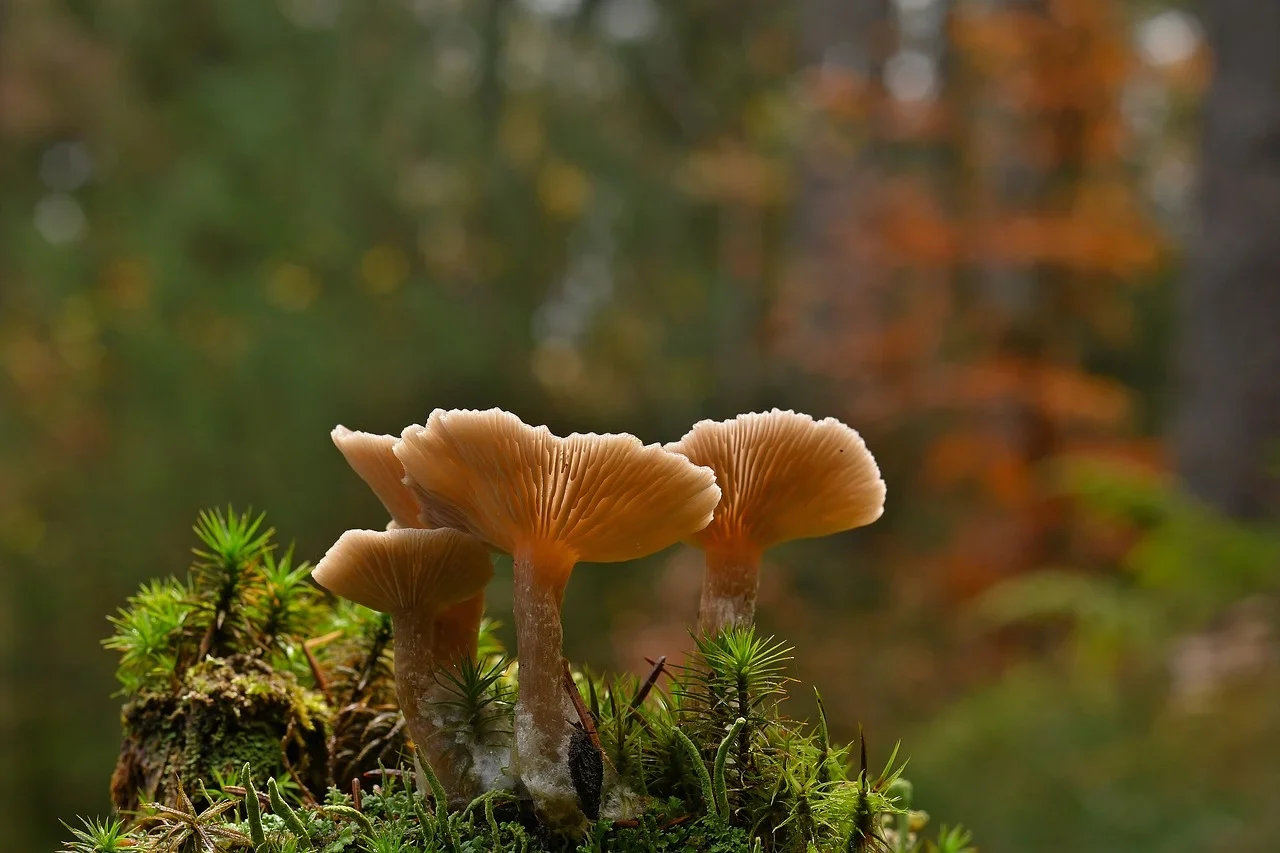
White Button Mushroom
Agaricus bisporus
A firm, dry cap 3–10 cm across, white to pale buff or brown, hemispherical at first and flattening with age, on a short stout stem carrying a single narrow ring. The gills begin pink and darken through chocolate brown to almost black, and cut flesh stains pinkish to reddish-brown. Best known as the shop mushroom sold as button, chestnut and portobello, but it also turns up wild on rich, disturbed ground.
Saprotrophic on nutrient-rich soil: manured pasture, compost heaps, wood chip, garden borders, roadside verges and stabilised dunes. Wild occurrences in Britain and Ireland are scattered and local rather than common, usually on ground disturbed or enriched by people.
Edible raw or cooked, though the flavour deepens with cooking and some people find it easier to digest cooked. Destroying Angel (Amanita virosa) is deadly and shares the white cap and ringed stem: its gills stay white at every age and its stem base sits in a sac-like volva, whereas this species has pink to brown gills and no volva. Avoid picking from verges, sprayed pasture or fly-tipped ground, where fungi take up contaminants.
Always use more than one reference to confirm a plant. You are responsible for what you choose to forage.
Cap
3–10 cm across, hemispherical then flattening, white to pale buff or dull brown, dry and smooth or breaking into fine flat scales. The surface carries no loose patches of veil tissue, which rules out the veil-flecked Amanita caps.
Gills
Free from the stem, crowded, pink when young and darkening through chocolate brown to near black with age. Gills that remain white at every stage mean it is not this species — stop there and discard.
Stem and base
Short and stout with a single fairly narrow ring. The base tapers or is slightly club-shaped and sits directly in the substrate, with no sac-like volva and no bulb enclosed in a membrane.
Bruising
Cut or rubbed flesh slowly turns pale pink then dull reddish-brown. A rapid chrome-yellow flush, especially at the stem base, points to the Yellow Stainer group instead.
Spore print
Dark chocolate brown. A white spore print on a white-capped, ringed mushroom is a warning sign and worth taking overnight before eating anything.
Updated 2026-08-07T20:30:47.288Z · Part of the shared Foragers Log catalogue · Fungus