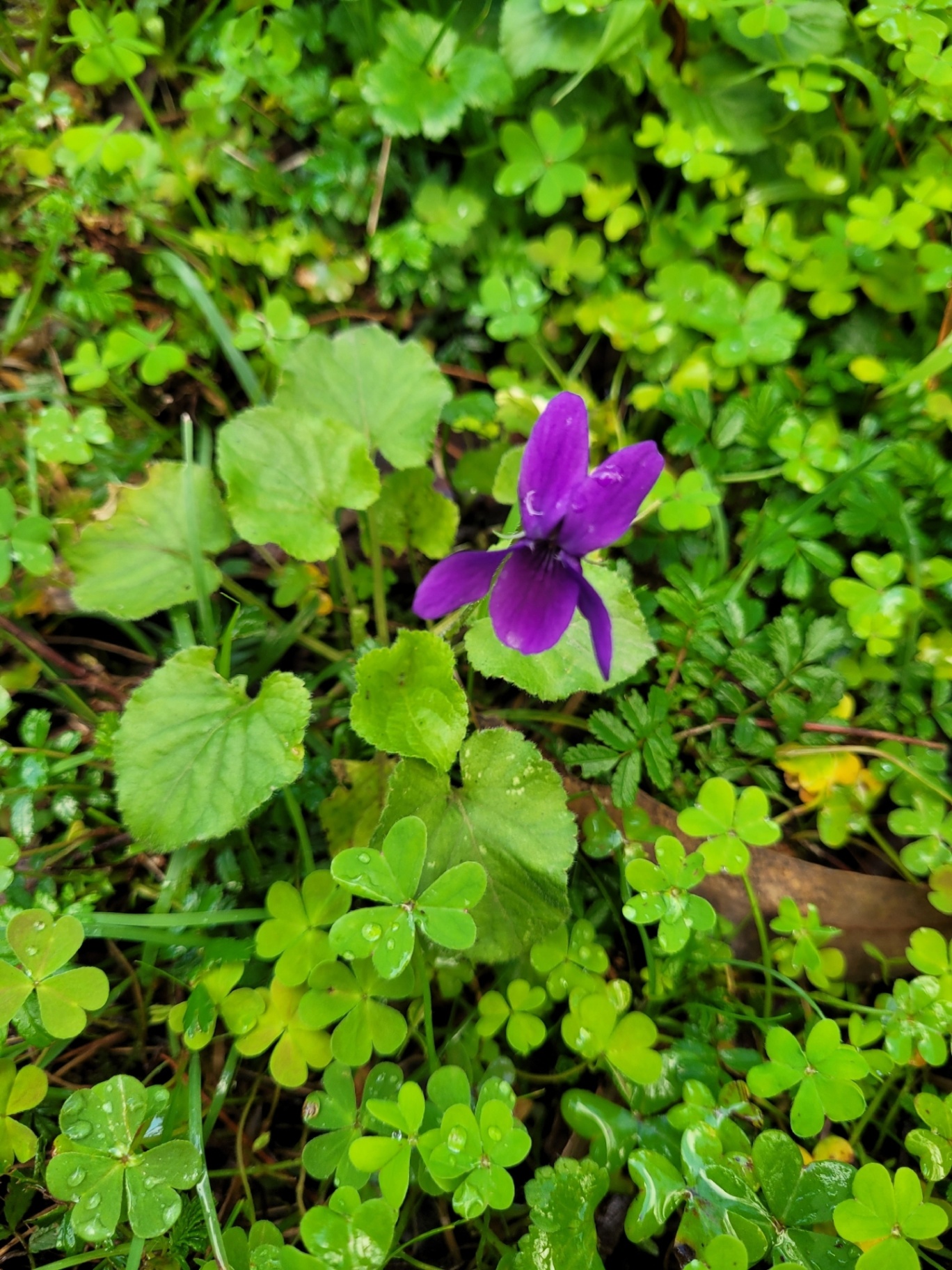
Sweet Violet
Viola odorata
A low, spreading perennial of hedge banks and wood edges, with heart-shaped leaves and deep violet or white flowers on curved stalks held close to the ground. The scent settles it: sweet and powdery, where the commoner dog-violets have none at all. Flowers are candied or steeped into syrups and cordials, and the young leaves are mild enough for salads.
Hedge banks, churchyards, wood edges, shaded verges and old gardens, on damp neutral to base-rich soils. Widespread through lowland Britain and Ireland, often as a garden escape, and usually in dense patches spread by rooting runners.
Flowers and young leaves are eaten raw or cooked with no known toxicity. The rhizome and seed capsules are a different matter, both containing saponins that are strongly emetic in quantity, so take the aerial parts only. Violets favour path edges and verges, so avoid sprayed or heavily walked ground.
Always use more than one reference to confirm a plant. You are responsible for what you choose to forage.
Leaves and flowers all rise from the base
There is no leafy upright stem. Every leaf stalk and flower stalk comes straight out of a rosette at ground level. The dog-violets, which are the commonest violets in UK woodland, carry their leaves on branching aerial stems.
Creeping runners that root as they go
Long runners spread across the ground from the parent rosette and root where they touch, so plants usually occur in spreading patches rather than singly. Hairy Violet looks similar at a glance but produces no runners.
Rounded leaves with a blunt tip
Leaves are heart- to kidney-shaped and softly hairy, rounded at the tip rather than drawn to a point, on a clear stalk. They enlarge considerably after flowering and are much bigger by early summer than they were in February.
Scent that fades as you smell it
Sweet Violet is scented and the dog-violets are not, which settles it. The scent contains ionone, which briefly desensitises the receptors that detect it, so it seems to disappear after a few seconds and returns a little later. A violet with no scent at all, tried more than once, is not this species.
Nodding spurred flower
Five unequal petals, the lowest carrying a short blunt spur at the back, on a stalk that curves over near the top so the flower hangs forward. White-flowered plants are frequent and are still this species.
Blunt sepals behind the flower
Turn a flower over and look at the five sepals: in this species they are rounded at the tip. Sepals that taper to a point indicate one of the dog-violets, which are scentless though harmless.
Leaves enlarge after flowering
The spring leaves are small and neat, but by midsummer the same plants carry much larger, kidney-shaped leaves on long stalks. Identify and pick in spring, when flowers are present to confirm the plant.
Updated 2026-08-08T12:03:18.286Z · Added 2026-06-21T18:18:05.662Z
Part of the shared Foragers Log catalogue · Flower