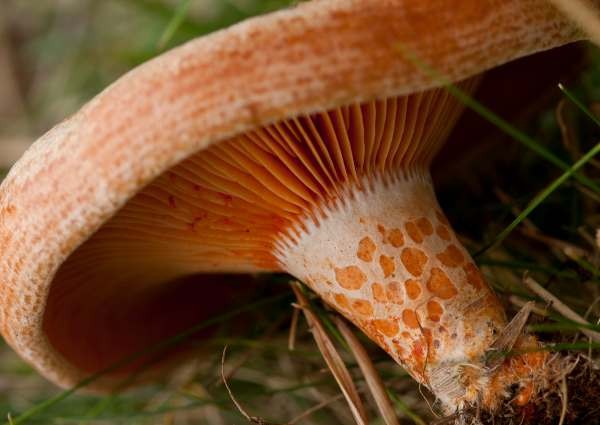
Saffron Milkcap
Lactarius deliciosus
A stout orange cap fungus, funnel-shaped when mature and marked with darker concentric zones, staining verdigris green where bruised or ageing. Cut gills bleed carrot-orange milk. The flesh is firm and slightly bitter, holding its texture when fried or roasted, and the species is gathered in quantity across southern Europe.
Mycorrhizal with pines, particularly Scots pine, on sandy or acid soils; look along plantation rides, heathy woodland edges and in needle litter. Scattered but locally frequent across Britain and Ireland, commonest in the south and east.
Cook thoroughly; raw milkcaps upset some stomachs. Woolly Milkcap (Lactarius torminosus) shares the same acid ground but bleeds white milk, never the carrot-orange latex of this species. A large meal can turn urine reddish-orange, which is harmless.
Always use more than one reference to confirm a plant. You are responsible for what you choose to forage.
Cap
Orange to brick-orange, 4–14cm, flattening then becoming funnel-shaped with an inrolled margin when young. Concentric darker zones or water-marked bands are usually visible from a distance, and older caps carry dull green patches.
Gills and stem
Gills are orange, crowded and run a short way down the stem, bruising green where touched. The stem is orange, often paler than the cap and sometimes shallowly pitted, becoming hollow with age.
Latex
Nick a gill or the stem flesh: the milk runs bright carrot-orange and only slowly dulls to reddish-brown. A milkcap in pine woods with white latex is a different species and should be left.
Greening
Cut surfaces, handling marks and old fruit bodies stain a dull verdigris green. Green staining alone does not confirm the species — several orange milkcaps do it — but its absence in a fresh, undamaged specimen is worth pausing over.
Updated 2026-08-08T12:03:11.384Z · Added 2025-08-25T07:07:05.461Z
Part of the shared Foragers Log catalogue · Fungus