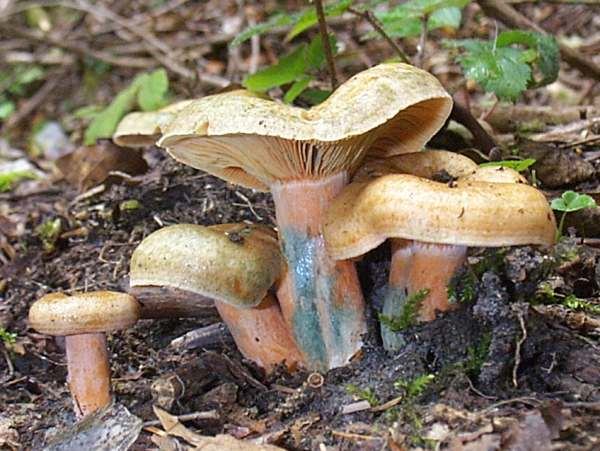
False Saffron Milkcap
Lactarius deliciosus
A stout, apricot- to carrot-orange milkcap with a shallowly funnel-shaped cap, often marked with faint concentric zones and an inrolled margin when young. Cut flesh and gills bleed carrot-orange milk, and bruised parts slowly stain dull green. Firm and slightly grainy, it holds its texture best grilled or fried rather than stewed.
Mycorrhizal with pine, particularly Scots pine, on sandy or well-drained acidic soils. Found in UK and Irish pine plantations, heathland fringes and stabilised dunes, often in troops among needle litter and moss.
Cook thoroughly; raw or undercooked milkcaps can upset the stomach. Any similar orange-capped milkcap whose milk is white rather than carrot-orange is a different species — Woolly Milkcap (Lactarius torminosus) has a pinkish, shaggy, strongly inrolled cap margin and acrid white milk, and causes vomiting. Eating this species can turn urine reddish, which is harmless.
Always use more than one reference to confirm a plant. You are responsible for what you choose to forage.
Cap
4–14 cm across, apricot to carrot-orange with faint concentric zoning, depressed at the centre with an inrolled margin when young. Handled or ageing areas stain dull greenish, which rules out the pink or white-capped milkcaps of the same woods.
Milk
Score the gills with a knife: the milk runs carrot-orange and stays orange, sometimes dulling to green over some minutes, and tastes mild rather than burning. White milk means a different species. Milk turning wine-red within about ten minutes, under spruce rather than pine, indicates the related Lactarius deterrimus.
Gills
Crowded, pale orange and running a little way down the stem, bruising green where touched. Not free from the stem, as in the Agaricus mushrooms.
Stem
Short, stout and orange, often with faint pits or scurf near the top, becoming hollow with age. There is no ring and no bag at the base.
Updated 2026-08-08T12:03:10.980Z · Added 2025-08-25T07:01:23.263Z
Part of the shared Foragers Log catalogue · Fungus