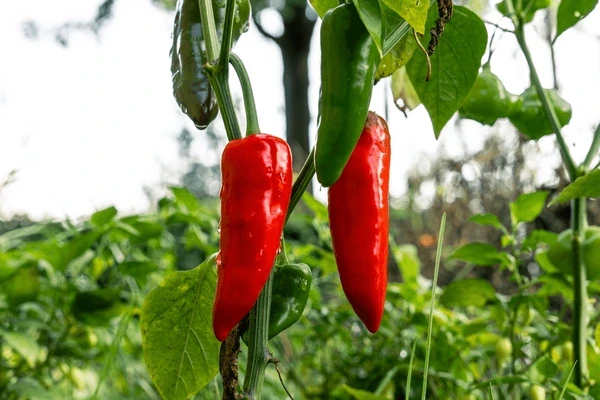
Pepper
Capsicum annuum
A bushy, brittle-stemmed annual of the nightshade family, grown for hollow, thick-walled fruit that ripens from green through yellow, orange or deep red. The same species covers both blocky sweet peppers and most culinary chillies, so heat rather than shape is what separates them on the plate. Eaten raw, roasted, stuffed or dried and ground.
Not a wild plant in Britain or Ireland. A frost-tender native of Central and South America, grown here under glass, in polytunnels or against a warm sheltered wall; stray seedlings from compost rarely fruit and do not persist.
The fruit, ripe or unripe, is eaten freely, but the leaves and stems are solanaceous and are not food. Plants sold as sweet types occasionally set a hot fruit, so taste a sliver before committing a whole one to a dish, and wash hands after cutting since capsaicin stings if rubbed into the eyes.
Always use more than one reference to confirm a plant. You are responsible for what you choose to forage.
Fruit
Blocky or bell-shaped, often four-lobed, hanging on a stout stalk with a hollow centre and walls 4–8 mm thick. Narrow, tapering, thin-walled fruit on an otherwise identical plant indicates a hot cultivar rather than a sweet one.
Leaves
Ovate, pointed, untoothed and smooth, mid to dark green, up to about 12 cm long and carried on a clear stalk. Crushed foliage smells faintly of tomato leaf, which places the plant in the nightshades.
Flowers
Star-shaped, about 15–20 mm across, held singly at each leaf joint, white with no purple blotching and with pale anthers. Two or more flowers per joint, or purple petals, suggests one of the other cultivated Capsicum species.
Seeds and core
Flat cream discs around 4 mm across, attached to a spongy white core inside the fruit. In hot cultivars this core and the surrounding membrane carry most of the capsaicin; in sweet peppers it is merely bitter and usually discarded.
Updated 2026-08-07T21:15:28.770Z · Part of the shared Foragers Log catalogue · Vegetable