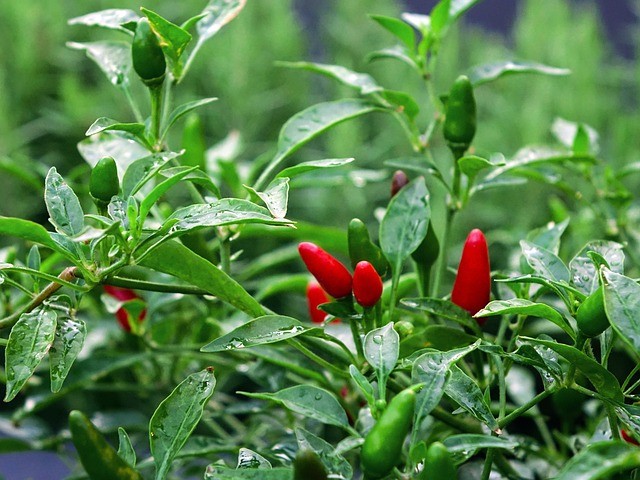
Chilli Pepper
Capsicum annuum
A bushy, frost-tender annual of the nightshade family, 40–80cm tall, with white star-shaped flowers and hollow fruit that ripens from green through yellow to red or purple. Almost every cayenne, jalapeño and bell type belongs here, and the heat sits in the pale core holding the seeds rather than in the wall of flesh. The boundaries with Capsicum chinense and C. frutescens are blurred at cultivar level, but the distinction matters little in the kitchen.
Not a wild plant in Britain or Ireland. Grown as a tender annual under glass, in polytunnels and on sheltered patios and windowsills, needing a long warm season to colour up; outside cultivation it turns up only as a short-lived casual on tips and disturbed ground.
Not toxic in normal culinary amounts, though capsaicin from the hot cultivars burns skin, eyes and mucous membranes; gloves are worth wearing when cutting quantity, and hands kept away from the face. Leaves and stems are not eaten. Ornamental fruiting nightshades are sometimes taken for ornamental chillies: Jerusalem cherry (Solanum pseudocapsicum) bears solid-fleshed round orange berries on a woody evergreen shrub, where chilli fruit is hollow with a papery seed core.
Always use more than one reference to confirm a plant. You are responsible for what you choose to forage.
Habit
An erect, freely branching plant, woody at the base by late summer, with smooth oval leaves tapering to a point and held on clear stalks. It is killed outright by the first frost rather than dying back to a rootstock, so nothing persists into a second year outdoors in Britain.
Flowers
Small white to greenish-white star-shaped flowers, usually borne singly at a node and hanging on a slender stalk. Solitary, pure white flowers separate it from Capsicum chinense, which typically carries two or more flowers per node, and from C. pubescens, whose flowers are purple.
Fruit in section
Cut lengthways the fruit is hollow, with flat cream disc-shaped seeds attached to a pale central placenta. That papery core carries most of the capsaicin, and the hollow interior is the quickest way to tell a chilli from the solid-fleshed berry of an ornamental nightshade.
Calyx and stalk
Ripe fruit sits on a shallow saucer-shaped green calyx and pulls away with a short piece of stalk attached. The calyx never encloses the fruit, unlike the inflated papery husk of tomatillo, which has to be peeled away before the fruit is visible.
Updated 2026-08-08T11:01:35.381Z · Part of the shared Foragers Log catalogue · Vegetable