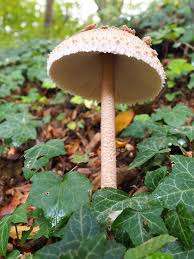
Parasol mushroom
Macrolepiota procera
A tall, elegant grassland mushroom with a cap that starts as a closed drumstick and opens to a broad parasol 10–25cm across, pale buff with coarse brown scales and a darker raised centre. The stem is long and slightly bulbous at the base, patterned with brown snakeskin banding, and carries a thick double-edged ring that slides freely up and down. Gills are free and white, the flesh nutty-smelling; the caps are prized fried or crumbed, the fibrous stems usually discarded.
Saprotrophic, growing from soil rather than wood: unimproved pasture, grassy verges, churchyards, woodland rides and clearings, often in loose troops or arcs. Widespread across the UK and Ireland, commonest on lighter, well-drained ground.
Eat cooked, and only the cap — stems are tough and indigestible. Shaggy parasol (Chlorophyllum brunneum) causes stomach upset in some people; its flesh bruises orange-red where cut and its stem is plain, without snakeskin banding. Deadly dapperling (Lepiota brunneoincarnata) is far smaller, with a cap under 5cm and a thin ring fixed to the stem. Grassland specimens from verges and dog-walked parks are best left.
Always use more than one reference to confirm a plant. You are responsible for what you choose to forage.
Stem banding
The stem is banded and mottled with brown scales in a snakeskin pattern over a pale ground, visible from a couple of metres away on a mature specimen. A smooth or plain fibrous stem points away from this species.
Movable double ring
The ring is thick, with a stepped double edge, and can be slid up and down the stem with a fingertip once the cap has opened. Rings that tear or stay fixed in place belong to other genera.
Cap scales and umbo
Coarse, flat brown scales sit on a pale buff surface, with an unbroken darker boss at the centre where the scales merge. Young specimens are closed and drumstick-shaped, the scales already present.
Flesh and spore print
Cut flesh is white and stays white or turns only faintly pinkish; the spore print is white. Flesh that bruises saffron to orange-red within a minute indicates a Chlorophyllum instead.
Smell
A mild, pleasantly nutty smell, with no trace of gas, radish or ink. A sharp or unpleasant smell means the identification should be reworked from the start.
Updated 2026-08-07T20:37:40.132Z · Part of the shared Foragers Log catalogue · Fungus