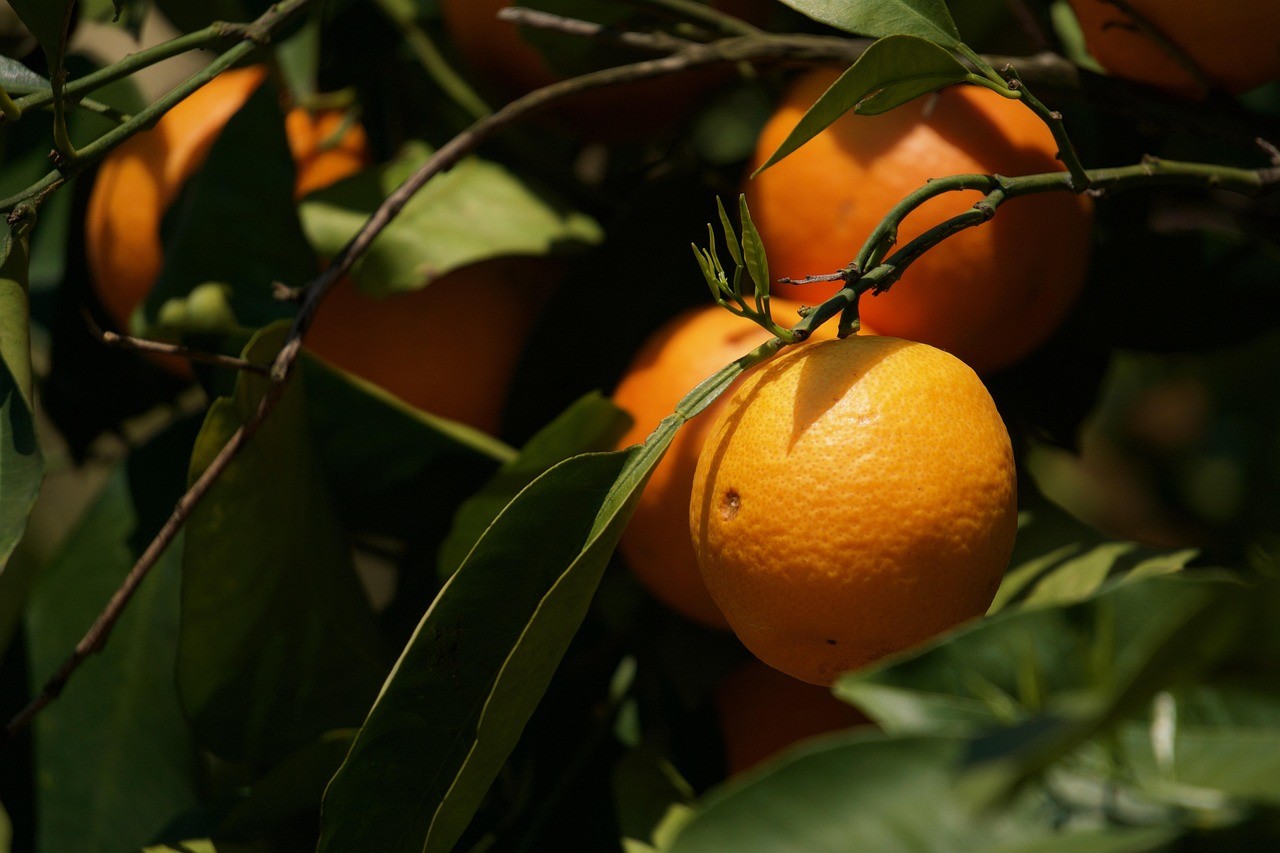
Orange
Citrus sinensis
A small evergreen tree with glossy, dark, aromatic leaves and intensely fragrant white blossom, bearing round fruit with a thin, tightly attached rind and sweet, segmented flesh. It is an ancient hybrid of mandarin and pomelo, so some authorities file it under Citrus × aurantium alongside the Seville orange. In the kitchen the sweet flesh and smooth rind settle which one is in hand.
Not naturalised in Britain or Ireland; a subtropical orchard tree of the Mediterranean and warmer regions. In the UK it is grown in pots, glasshouses and conservatories, or trained against a sheltered south-facing wall and moved under cover before the first frosts.
The flesh and peel are eaten without special preparation and no part of the plant is toxic. Shoots of some trees carry short, sharp spines. Peel oils can irritate skin on prolonged handling, and the juice stings broken skin or split lips. Glasshouse trees may have been sprayed, so wash fruit before zesting.
Always use more than one reference to confirm a plant. You are responsible for what you choose to forage.
Fruit and rind
Round to slightly oval, 6–10 cm across, the rind orange when ripe, finely pitted and held tightly to the flesh so it peels with some resistance. Mandarins have a loose, puffy rind that lifts away in one piece; the Seville orange's rind is thicker, rougher and more dimpled.
Leaf stalk
The petiole carries only a narrow wing, a thin flange either side rather than a broad flap. The Seville orange has a conspicuously broad, heart-shaped petiole wing, and lemon leaves are essentially unwinged.
Blossom
White, five-petalled and heavily scented, borne singly or in small clusters in the leaf axils, mostly in spring but sometimes sporadically indoors. Buds and petals are white throughout, without the pink flush seen on lemon buds.
Crush test
A crushed leaf smells sweetly of orange peel rather than sharply of lemon or of the resinous, slightly medicinal scent of bitter orange foliage. If the smell is lemony, it is not this tree.
Twigs and spines
Young shoots are angular and green, sometimes bearing short spines at the leaf bases, though many cultivated trees are nearly spineless. Long, rigid thorns on a small downy fruit point instead to hardy orange, Citrus trifoliata.
Updated 2026-08-08T06:53:02.379Z · Part of the shared Foragers Log catalogue · Fruit