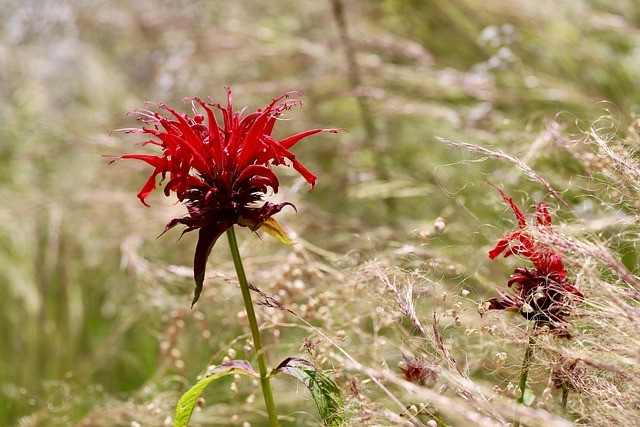
Monarda
Monarda didyma
A tall, clump-forming perennial of the mint family, with square stems and opposite, veined leaves that smell of oregano and thyme when crushed. The flowers settle the identification: a dense terminal head of narrow scarlet tubes sitting on a ruff of red-tinged bracts, often with a second whorl above the first. Leaves and flowers are used fresh or dried for the citrus-edged tea long known as Oswego tea.
In Britain and Ireland this is a garden plant rather than a wild one, native to damp woodland edges and stream banks in eastern North America. Escapes appear on damp waste ground, hedge banks and tips near habitation, rarely persisting long.
No toxic constituents are recorded and both leaves and flowers are eaten, most often as a tea. The aromatic oils are strong, so quantities that suit the pot are larger than those that suit a plate. Garden and border stock may have been sprayed. It has nothing to do with the bergamot orange used to flavour Earl Grey.
Always use more than one reference to confirm a plant. You are responsible for what you choose to forage.
Flower head
A single dense head 5–8 cm across made of narrow scarlet tubes, seated on a ruff of reddish-green bracts, with a second head often forming on a short stalk directly above the first. Visible from across a garden and unlike any other UK-grown labiate.
Stem
Square in cross-section, faintly grooved and often reddish at the nodes. Checking this first places the plant in the mint family before any scent or flower detail matters.
Leaves
Opposite and set in pairs at right angles up the stem, ovate and drawn to a point, toothed, on a short but clear stalk. Often bronze-flushed along the veins, unlike the plain green of catmint.
Scent when crushed
Oregano and thyme with a citrus lift, not the cool sweetness of mint or peppermint. A frankly minty or musty smell means you have another member of the family rather than this plant.
Habit
Clump-forming perennial 60–120 cm tall, spreading by shallow surface runners into wide patches and dying back to ground level each winter.
Updated 2026-08-08T07:14:22.448Z · Part of the shared Foragers Log catalogue · Herb