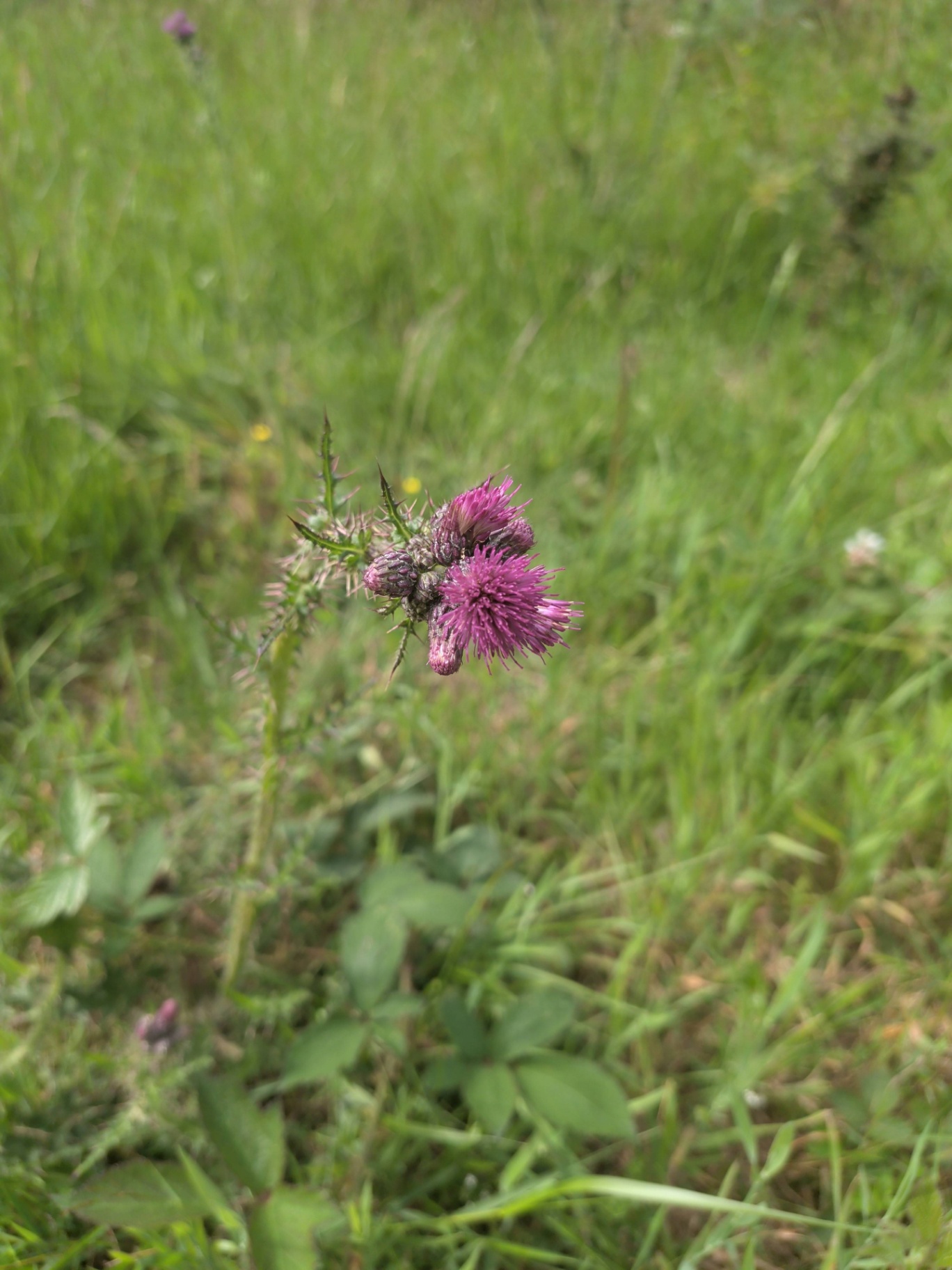
Marsh Thistle
Cirsium palustre
A tall biennial thistle carrying a single slender stem that is spiny-winged from base to tip, topped by tight clusters of small dark red-purple flowerheads. The narrow leaves are deeply lobed, softly hairy and often purple-tinged, running down the stem as continuous prickly wings. Young peeled stems and leaf midribs are cooked as a vegetable, and the flowers are one of the heaviest nectar sources of damp grassland.
Wet ground: marshes, fens, rushy pasture, wet meadows, moorland flushes, and the damp sides of woodland rides and ditches. Widespread and common throughout Britain and Ireland, favouring neutral to acid soils.
Spines run the whole length of the winged stem and along every leaf edge, so gloves are wanted and stems need peeling before cooking. No British thistle is known to be poisonous, so the practical risk here is injury rather than misidentification. Those sensitive to other daisy-family plants may react to the sap, and plants from grazed or sprayed pasture are best left.
Always use more than one reference to confirm a plant. You are responsible for what you choose to forage.
Stem
Tall and slender, often 1–2 m, with a narrow spiny wing of leaf tissue running unbroken from the ground to the flowerheads. Creeping thistle, the other common thistle of damp grassland, has an unwinged, smooth-sided stem.
Flowerheads
Small, barely 1.5 cm across, dark red-purple and packed into tight clusters at the stem top rather than held singly. Occasional plants have white heads.
Leaves
Narrow, deeply lobed and hairy on both faces, dull dark green and frequently flushed purple towards the base of the plant. Each lobe ends in a weak spine.
Involucral bracts
Purple-tinged, cobwebby with fine hairs and pressed close to the head, with only short soft points — not the stiff outward-curving spines of spear thistle.
First-year rosette
A flat rosette of lobed hairy leaves on wet ground through the first year, producing no stem. This is the stage most often picked for the leaf midribs.
Updated 2026-08-08T12:03:05.697Z · Added 2026-06-20T15:07:07.742Z
Part of the shared Foragers Log catalogue · Flower