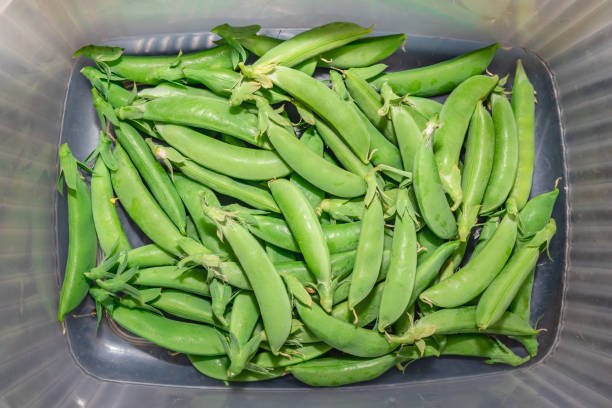
Mangetout
Pisum sativum saccharatum
A climbing annual legume grown for its flat, tender pods, which are picked young and eaten whole, seeds and all, before the peas inside swell. The pods lack the tough inner parchment layer that makes a shelling pea's pod inedible, so the whole thing snaps crisply. Plants carry blue-green paired leaflets ending in branched tendrils, and typically white pea flowers.
A cultivated plant of vegetable beds and allotments, grown on netting, canes or pea sticks in open sun on moist, well-drained ground. Occasionally persists as a relic on tipped soil and waste ground in Britain and Ireland, but not naturalised.
Pods and immature seeds are eaten raw or cooked and need no preparation, though quantities of raw pods sit badly with some people. Sweet pea (Lathyrus odoratus) is often grown on the same supports and its seeds are toxic if eaten: its stems are broadly winged and its flowers showy and strongly scented, whereas mangetout has rounded stems and small, unscented white flowers. Rinse pods picked beside busy roads.
Always use more than one reference to confirm a plant. You are responsible for what you choose to forage.
Pods
Flat and slightly translucent, roughly 6–10cm long, with the developing seeds showing only as faint bumps. Snapped in half, the inner wall is smooth and fleshy with no papery lining.
Flowers
Typical pea flowers, usually white, sometimes bicoloured purple in older cultivars, and without scent. A strong sweet perfume means you are looking at an ornamental Lathyrus rather than a mangetout.
Leaves and stipules
Pinnate with one to three pairs of oval, blue-green leaflets, the leaf ending in branched tendrils. The pair of leaf-like stipules clasping the stem is often larger than the leaflets themselves.
Stems
Rounded to faintly angled and hollow, climbing by tendrils rather than twining. Never broadly winged along their length.
Updated 2026-08-08T11:01:29.686Z · Part of the shared Foragers Log catalogue · Vegetable