Peas
Pisum sativum
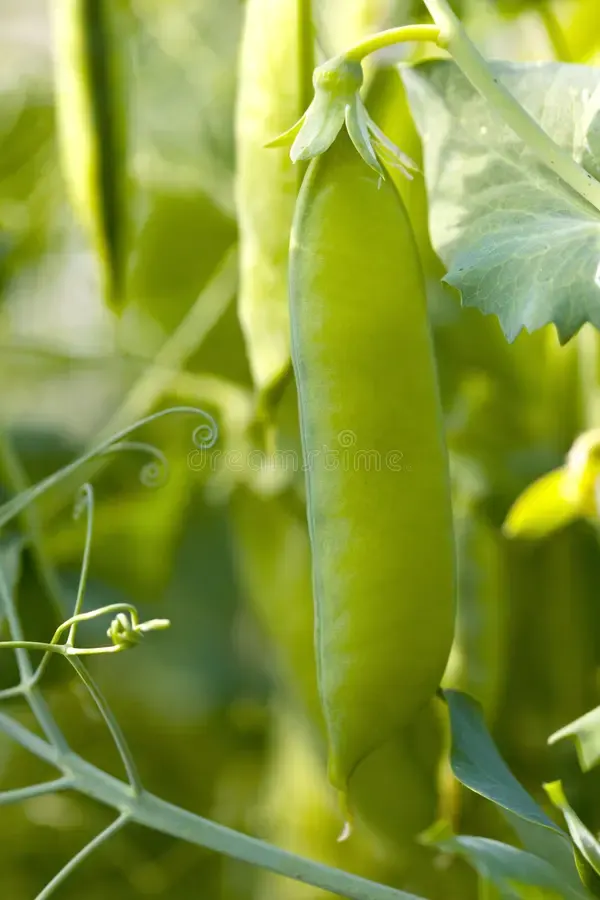
A scrambling blue-green annual legume, hairless throughout, climbing to around 2 m on branched tendrils that end each pinnate leaf. White butterfly-shaped flowers, borne singly or in pairs from the leaf axils, give way to plump pods holding four to ten round seeds. Grown for the shelled seeds, for the whole young pod, or for the sweet leafy shoots. A garden and allotment plant rather than a wild one, though it turns up as a short-lived escape.
A cultivated annual of vegetable beds and allotments, sown into open, well-drained ground in full sun. Not native to Britain or Ireland; it appears occasionally as a casual on tips, waste ground and arable margins near field-pea crops, but rarely persists.
Young pods and soft seeds are eaten raw or cooked with no special preparation; mature dried peas need soaking and long boiling. Ornamental sweet pea (Lathyrus odoratus) scrambles through the same gardens and sets similar pods, but its seeds are not for eating: its strongly scented pink or purple flowers and flattened, winged stems separate it from the garden pea's white flowers and rounded stems.
Always use more than one reference to confirm a plant. You are responsible for what you choose to forage.
Habit and colour
A soft, hairless, distinctly blue-green (glaucous) climber to about 2 m, scrambling on canes or netting rather than twining. The waxy grey-green tone reads from several metres away and separates it from the fresher green of beans grown alongside.
Stipules
Each leaf has a pair of large leaf-like stipules clasping the stem at its base, often bigger than the leaflets themselves. No other common climbing legume in a UK vegetable bed shows stipules on this scale, and they are the single most reliable feature when the plant is not in flower.
Leaves and tendrils
Pinnate, with one to three pairs of oval leaflets, the leaf ending in a branched tendril instead of a terminal leaflet. Semi-leafless varieties push this further, replacing most leaflets with tendrils.
Flowers
White and pea-shaped, one or two on a short stalk from a leaf axil; field-pea forms may be pink to purple. Vetches, by contrast, carry many smaller flowers in a one-sided spike.
Stem section
Roll the stem between finger and thumb: it is rounded and slightly hollow. Sweet pea and the everlasting peas (Lathyrus latifolius and relatives) have flattened, winged stems, so a winged stem rules the garden pea out.
Updated 2026-08-07T21:05:46.914Z · Part of the shared Foragers Log catalogue · Vegetable