Lemon Balm
Melissa officinalis
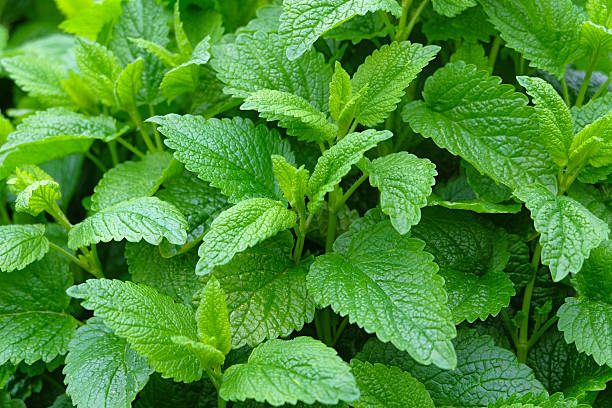
A soft, clump-forming perennial of the mint family, with square branching stems and wrinkled, deeply toothed leaves in opposite pairs that give off a clear lemon scent when crushed. Small white to pale cream flowers sit in whorls at the leaf joints through summer. Grown for centuries as a garden herb and now widely naturalised, the leaves are used fresh or dried for infusions and to scent puddings, dressings and fish.
A garden escape naturalised on hedge banks, roadsides, churchyards, railway sides and waste ground, favouring well-drained soil in sun or light shade. Commonest in southern and central England, scattered and largely lowland further north and in Ireland.
No known eating toxicity: the leaves are long established as a culinary herb and infusion. The safeguard when gathering is the crush test — if a square-stemmed plant gives no clear lemon scent, leave it alone. Avoid sprayed or traffic-side verges, and anyone taking thyroid or sedative medication may prefer to ask a pharmacist before drinking it regularly.
Always use more than one reference to confirm a plant. You are responsible for what you choose to forage.
Habit and height
An upright, loosely branched clump 40–100 cm tall, usually in a patch rather than as a single stem, dying back to the base over winter. Softly leafy throughout, with no woody stem at the base — unlike the shrubby lower stems of sage or rosemary.
Stem
Square in cross-section and finely hairy, confirming a member of the mint family. Roll it between finger and thumb to feel the four edges; a round stem rules the plant out.
Leaves
Broadly oval to heart-shaped, strongly wrinkled between the veins, bluntly and deeply toothed, and carried in opposite pairs on clear leaf stalks. The stalk is obvious, not the near-stalkless attachment of the true mints.
Flowers
Small, two-lipped and white to pale cream, in tight whorls tucked into the leaf axils rather than in a showy terminal spike. This is what separates it from catmint and the lavenders at flowering time, both of which carry lilac or blue flowers in a spike at the stem tip.
Scent
Crushing a leaf releases a clean lemon-sherbet smell, sharper than lemon verbena and quite unlike the sweet or menthol note of the mints. This is the decisive test: no lemon, not lemon balm.
Updated 2026-08-07T21:05:42.455Z · Part of the shared Foragers Log catalogue · Herb