Lemon
Citrus limon
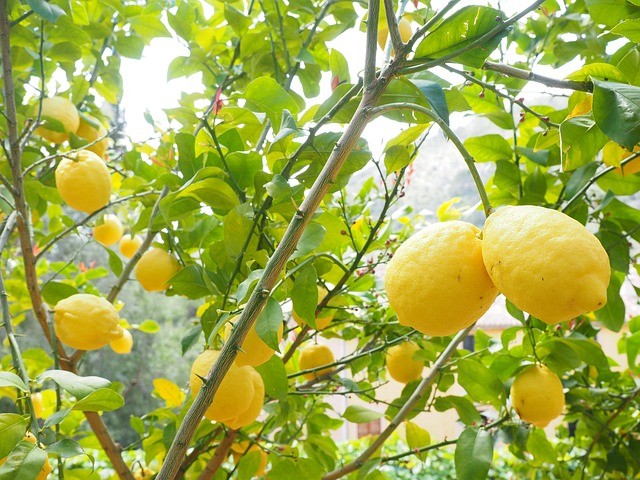
A small evergreen tree with stiff, spiny branches and glossy, elliptic leaves that smell strongly of the fruit when crushed. White flowers, purple-flushed in bud, open in flushes alongside ripening fruit. The oval yellow fruit has a small nipple at one end and a thick, oil-pitted rind over acid, pale flesh. Thought to be an ancient hybrid of citron and sour orange; in Britain it is a container and glasshouse plant, not a wild one.
Not naturalised in Britain or Ireland and not found growing wild here. Grown in pots, conservatories and heated glasshouses, stood outdoors in summer and kept frost-free through winter, in free-draining compost and full sun. Orchards are Mediterranean and subtropical.
The fruit is not toxic, but the peel oil contains furocoumarins that can raise a blistering rash on skin exposed to strong sunlight after handling. The juice is strongly acidic and erodes tooth enamel over time. Branches carry sharp spines. Shop fruit is usually waxed and post-harvest treated, so scrub the rind before zesting.
Always use more than one reference to confirm a plant. You are responsible for what you choose to forage.
Leaf
Elliptic, leathery and glossy, with a finely toothed margin and a narrow, barely winged leaf stalk. Crushed, it smells distinctly of lemon rather than the sweeter scent of an orange leaf, whose stalk is broadly winged.
Flower
Five white petals, purple or pink on the outside when in bud, borne singly or in small clusters. The purple flush is the easiest way to separate a lemon in flower from an orange, whose buds and petals are pure white.
Fruit shape
Oval and drawn out to a small blunt nipple at the stylar end, with a thick rind pitted with oil glands. Round, nipple-less fruit on a citrus tree points to an orange or grapefruit rather than a lemon.
Spines
Young shoots carry stout, straight spines in the leaf axils, longer and more numerous than on most sweet oranges. Handle the tree by the stem rather than the shoots when picking.
Habit under UK conditions
Rarely more than two metres in a pot, flowering and fruiting more or less continuously so that blossom and ripe fruit are often on the plant at the same time. It will not survive an unprotected British winter outdoors.
Updated 2026-08-08T06:53:00.790Z · Part of the shared Foragers Log catalogue · Fruit