Dryad's Saddle
Cerioporus squamosus
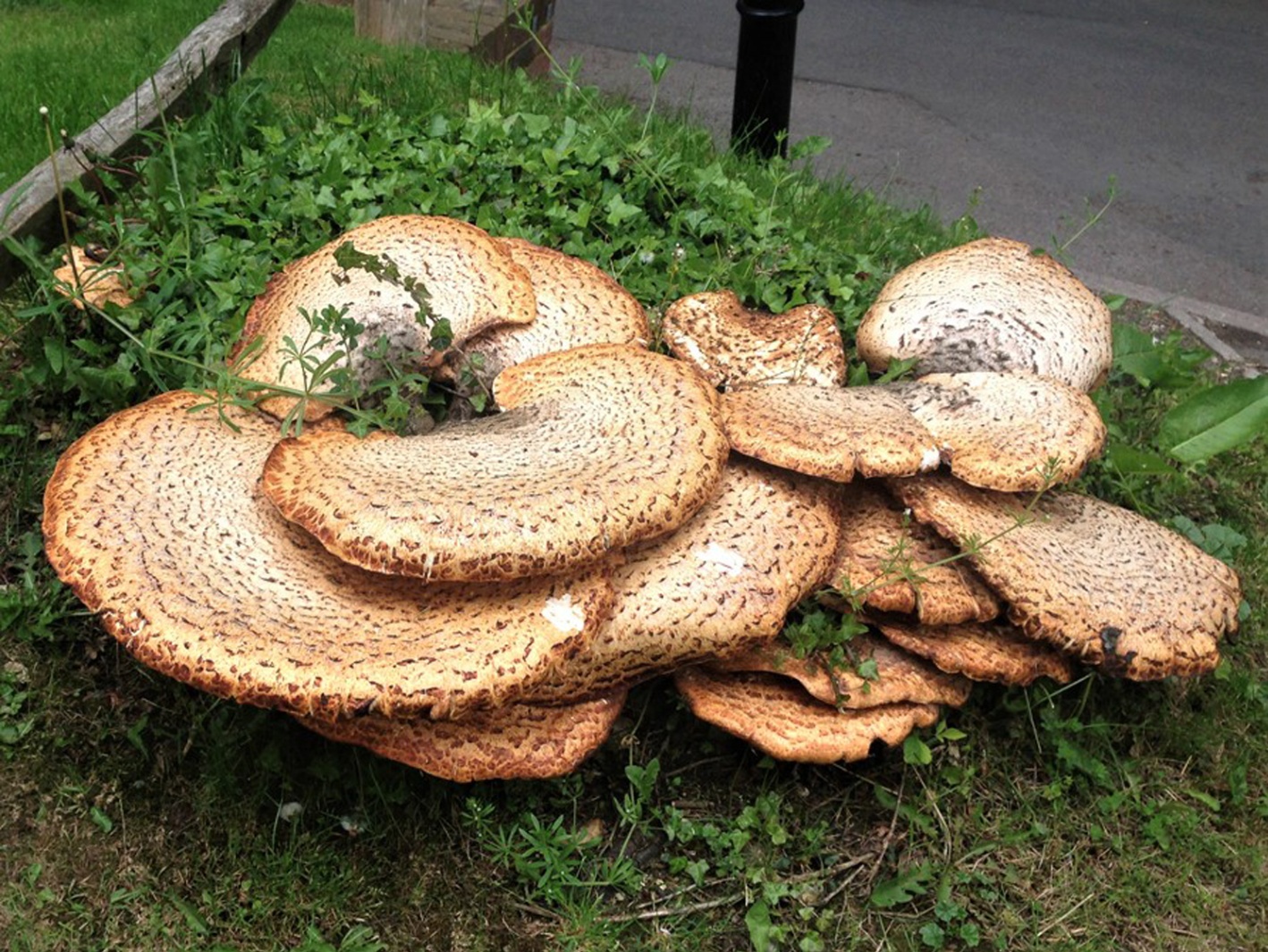
A large fan- or kidney-shaped bracket, tan to buff, with flat dark brown scales arranged in rough rings, growing singly or in overlapping tiers from broadleaf trunks. The underside is a sheet of angular white pores running down onto a short, off-centre stalk. Young flesh smells strongly of cucumber or watermelon and is fried or dried for stock; within a few days it turns corky and tough.
Saprotrophic, and a weak parasite causing white rot on living broadleaves — most often elm and sycamore, also beech, ash, horse chestnut and maple. Found on standing trunks, stumps and fallen logs in woodland, parks and hedgerows throughout Britain and Ireland.
Not toxic, but only the young, pliable outer flesh is worth taking; mature brackets are corky and indigestible. A few people report stomach upset even from young material, so cook it and try a small portion first. Brackets at head height often sit on unstable deadwood, so check the trunk before pulling.
Always use more than one reference to confirm a plant. You are responsible for what you choose to forage.
Concentric brown scales on a tan cap
Flattened dark scales lie in rings across a creamy-tan surface, broadest at the edge. The cap can reach 60cm, which is larger than any bracket it is likely to be confused with.
Angular white pores, never gills
The underside is a whitish layer of angular pores, wide enough to see without a lens. Anything with gills or with downward-pointing spines is a different fungus.
Off-centre stalk, black at the base
A short thick stalk joins the cap away from its centre and darkens to near-black where it meets the wood. Most true brackets have no stalk at all.
Smell of cucumber or watermelon
Fresh specimens have a strong, clean, melon-like scent that carries at arm's length. It fades as the bracket ages, which is a useful sign it is past eating.
Large fan or kidney-shaped bracket, often tiered
Individual caps commonly 10–40cm across and occasionally larger, growing singly or in overlapping shelves from a trunk or stump. Size alone separates it from the small scaly polypores that fruit on twigs and buried wood.
Flesh soft when young, corky within days
White flesh that bends and cuts like a firm mushroom when fresh, stiffening to leather over a few days. Test the outer margin with a thumbnail — if it resists rather than dents, the whole bracket is past eating.
Appears in spring, ahead of most brackets
One of the first large fungi of the year, often out from May while most polypores are still autumn prospects. A big scaly bracket on elm or sycamore in late spring is very likely this species.
Updated 2026-08-08T12:03:25.588Z · Added 2026-06-18T06:22:39.286Z
Part of the shared Foragers Log catalogue · Fungus